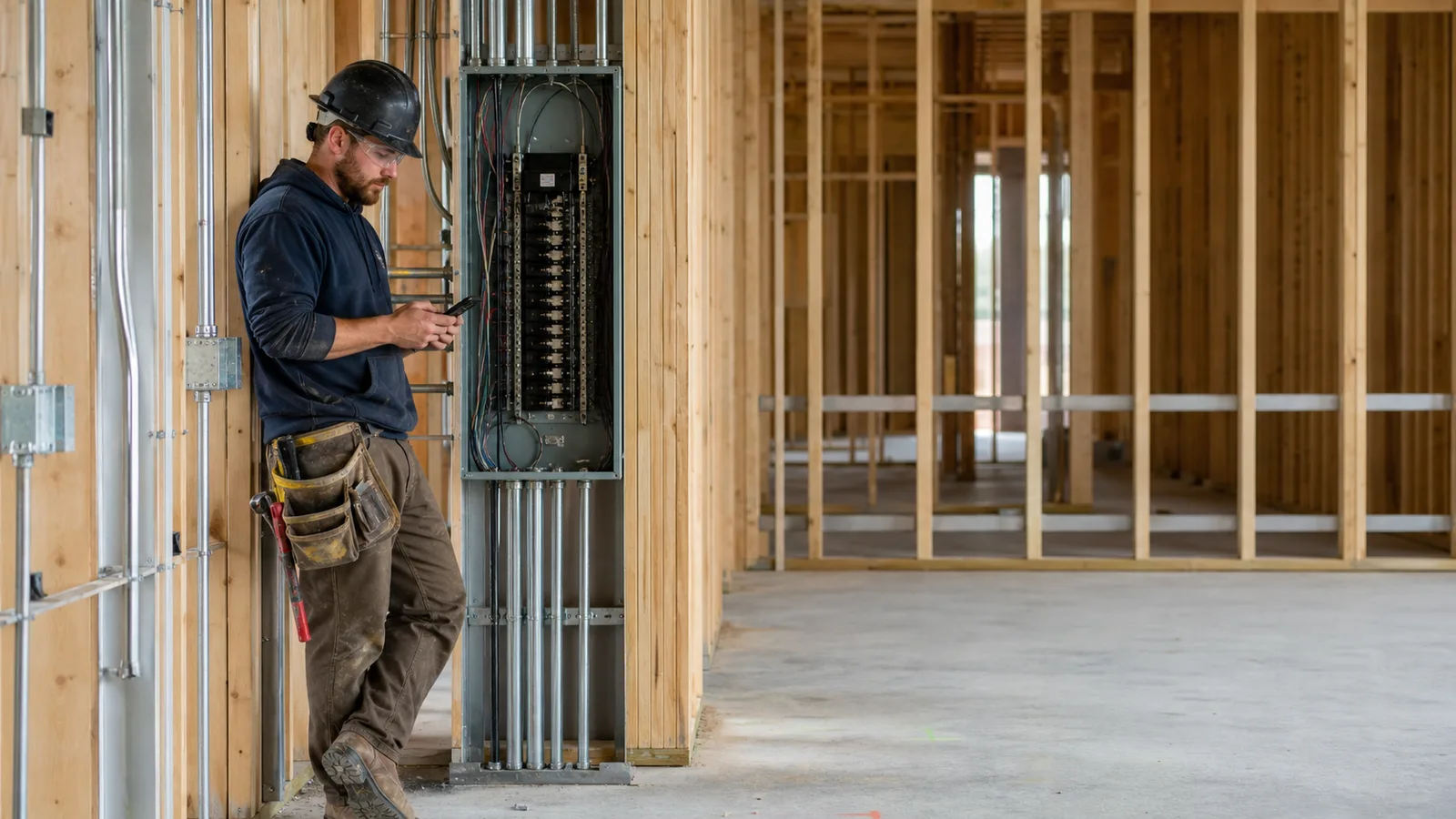
The invoice goes out Friday. Monday the GC calls, and he is only calling about one line: 6.5 hrs — permit and inspection.
He is not disputing the rough-in. He is disputing the hours where nothing visible happened.
Electrician permit inspection wait time billing falls apart at exactly that line. The charge is usually fair. The explanation is usually missing.
Nobody argues with terminations they can see in the panel. They argue with hours that have no work attached to them.
Here is the part that decides it: the note the crew wrote in the field that day is the customer's explanation. There is no second source.
6.5 hrs — permit and inspection loses the argument. Tue 7:55a–11:40a — 2 electricians held on site for county rough-in, AHJ window 8a–12p, inspector arrived 11:15a ends it.
Same hours. Same money. Opposite conversation.
Is Permit and Inspection Wait Time Billable?
Under a time-and-materials or cost-plus contract, yes — permit runs and inspection standby are billable labor, provided the authorization says so and the field record proves it. Under fixed price they are absorbed unless a change order covers them.
That is the whole contractual answer. The rest of this post is the documentation problem, which is where the money actually leaks.
Two things make a wait-time line survivable: pre-authorization before the truck rolls, and a field record with a named cause of delay. Miss either one and the charge gets negotiated after the fact from a weak position.
The Permit Fee and the Permit Hours Are Two Different Line Items
The fee is money advanced and recovered. The hours are labor sold. Combining them into one number is the fastest way to make an invoice look padded.
A customer who sees a line like Permit — $580 (example figure — use your own AHJ's published fee) assumes that is the city's charge. When it quietly includes two hours of an electrician's time, and they later look up the fee schedule, that is a credibility problem nobody needed.
| Charge | What it is | How to show it |
|---|
| Permit fee | The AHJ's published fee, advanced by the contractor | Pass-through line at cost, with the permit number and the receipt attached |
| Permit acquisition labor | Write-up, application, drive time, counter time, return trip to sign and pay | Labor line with hours, rate, and what was done |
| Inspection standby labor | Licensed electrician held on site for the AHJ window | Labor line with the window, the arrival time, and who was held |
| Re-inspection fee | The AHJ's charge for a second trip | Pass-through line — but only when the failure was not yours |
Count the permit pull as its own labor line: the write-up, the drive to the counter, counter time, and the return trip to sign and pay. None of that is in the fee. Time it on the next permit and use your own number instead of an estimate.
Many jurisdictions also require the permit holder or a licensed electrician to be physically present for the inspection. That requirement is what creates the standby hour — the crew cannot leave and come back when the inspector arrives.
Who Caused the Delay Decides Who Pays for It
Billability turns on cause, not on hours. A wait caused by the owner, the GC, another trade, or the AHJ is billable. A wait caused by your own failed rough-in is not.
Conceding that last row is what makes the other five believable. An owner who has seen a contractor eat one of these stops fighting the rest.
| Cause of the wait | Billable? | What the note has to say |
|---|
| AHJ arrival window — inspector shows late inside a four-hour block | Yes, under T&M | Window as issued, actual arrival time, who was required on site |
| Inspector no-show or same-day cancellation | Yes | Confirmation number, who was called and when, time the crew was released |
| GC never scheduled it, or scheduled it for a day the site was not ready | Yes | Who scheduled it, what was not ready, who was notified on site |
| No access — panel room locked, utility service not released, temp power not energized | Yes | Arrival time, what blocked access, who was notified, release time |
| Inspector rejected another trade's work and pulled the whole inspection | Yes | Correction notice number, whose scope failed, status of your work |
| Your rough-in failed the inspection | No | Record it plainly anyway — the correction items are what makes the re-inspection pass |
That last row is not a moral point, it is a practical one. The correction notice is the punch list for the return trip.
A crew that writes the failure down honestly is the crew that does not fail twice.
What the Field Note Has to Say for the Inspection Hour to Survive an Audit
Seven fields. If all seven are in the record, the customer can reconstruct the charge without taking anyone's word for it. If any are missing, they can't.
- Permit number. It ties the hours to a public record the customer can verify.
- Inspection type. Rough-in, service equipment, or final — not interchangeable, and they carry different presence requirements.
- The window as the AHJ issued it. "8a–12p," not "morning."
- Actual inspector arrival time. The single number that turns a claim into a fact.
- Who was held, by name. One electrician or two changes the amount by 100%.
- What the crew did while held. The field nobody fills in, and the one that ends the argument.
- Result. Passed, failed with correction items, or no-show.
"Staged second-floor MC, prepped the panel schedule, pulled the last three homeruns to the J-box while held" reads as a crew that did not waste the owner's money.
The same 3.75 hours, written two ways
Written the way most crews write it:Standby — 3.75 hrs
Written so it survives:
Tue 8/12, 7:55a–11:40a — 2 electricians held on site for county rough-in inspection, permit E-24-3318. AHJ window 8a–12p; inspector arrived 11:15a. Rough-in passed, no corrections. While held: staged 2nd-floor MC, prepped panel schedule, pulled 3 homeruns to J-box 2E.
The hours did not change. The rate did not change. The second version is a receipt; the first one is a request.
The same mechanism applied to ordinary production hours is covered in T&M billing best practices. The sample billing packet shows what that line looks like once it reaches the customer.
The Four-Hour Window: Full Rate, Standby Rate, or Redeploy
There are three honest options when the AHJ issues a window instead of an appointment. Pick one before the day starts and put it in the authorization — picking it after the fact looks like negotiating.
| Option | When it fits | The trade-off |
|---|
| Full rate, whole window | Occupied buildings, service work, anywhere the crew genuinely cannot leave | Highest recovery, hardest to defend without a complete field record |
| Reduced standby rate | Where the customer relationship matters more than the last $350 on this invoice | Gives up margin and buys credibility — a lower rate on standby hours stops the line reading as padding |
| Hold one licensed hand, redeploy the rest | Multi-crew jobs, or a second job inside a short drive | Smallest charge and the easiest conversation, but you own the risk if the inspector wants a second body |
The reduced standby rate is worth a second look. It costs real margin, and what it buys is the rest of the invoice — pricing waiting differently from working is what tells the customer the production hours were priced honestly too.
To put numbers on what a contested invoice costs once it reaches a second round of emails, the invoice dispute calculator runs it with your own figures.
Failed Inspection, Re-Inspection Fee, and Return Trip Are Three Separate Charges
Contractors conflate these constantly, then wonder why the customer pushes back on all three at once. They have different causes, different amounts, and different answers to "who pays."
| Charge | Who eats it when your work failed | Who eats it when someone else caused it |
|---|
| Correction labor — fixing the flagged items | Contractor | Customer, as T&M or a change order |
| Re-inspection fee charged by the AHJ | Contractor | Customer, as a pass-through at cost |
| Return trip — drive, mobilization, standby for the second window | Contractor | Customer, at the normal or standby rate |
The return trip is its own billing problem, handled separately in mobilization and remobilization charges. Wait time that has nothing to do with the permit cycle — parts on backorder, a GC who is not ready — is covered in billing standby time.
One practical note on failed inspections: photograph the correction notice the day it is issued and write the notice number into that day's record. When the second inspection passes, that pair of records is the entire proof that the second trip was necessary and that it was completed.
If the correction was verbal — the inspector said fix it and left nothing in writing — the documentation rules in verbal change order documentation apply here too.
Put It in the T&M Authorization Before the Truck Rolls
The standby argument is won in the authorization, not on the invoice. Here is language to adapt — have an attorney review it, and check it against state rules on marking up permit fees, which some jurisdictions restrict on residential work.
Permits and inspections. Contractor will obtain the electrical permits required for this scope. Permit and re-inspection fees are reimbursable at cost and are not included in the labor rates stated above.>
Time spent preparing the permit application, filing it, and traveling to and from the permitting office is billable labor at the rates stated above.>
Where the authority having jurisdiction (AHJ) issues an arrival window rather than a fixed appointment, standby time for personnel required to be present is billable from the earlier of the start of the window or the crew's required arrival on site, until the inspector releases the crew, at $___ per hour per electrician.>
If an inspection fails due to work performed by Contractor, Contractor bears the re-inspection fee, the correction labor, and the return trip. If an inspection fails, is delayed, is rescheduled, or is missed for any other reason — including site access, incomplete work by others, Owner-directed changes, or AHJ scheduling — the re-inspection fee, standby time, correction labor, and return trip are billable to Owner.>
Contractor will provide, on request, the permit number, the scheduled inspection window, the actual inspector arrival time, and the personnel held for each standby charge.
That last paragraph does more work than it looks like. Promising the record in the contract is what makes the customer stop demanding it later — and it forces the operation to actually keep it.
The T&M Billing Backup Kit includes a T&M work authorization and a daily field report that this clause drops into cleanly.
The Permit and Inspection Log — Copy This
One row per permit event. A clipboard in the truck runs this fine. So does a note on a phone, as long as it gets written the same day.
| Field | Example entry |
|---|
| Date | Tue 8/12 |
| Job / permit # | Building B / E-24-3318 |
| Event | Rough-in inspection, county |
| Window as issued | 8:00a–12:00p |
| Crew held — names + count | 2 electricians |
| On site / released | 7:55a / 11:40a |
| Inspector arrival | 11:15a |
| Result | Passed, no corrections |
| Cause of delay | AHJ window — not owner, not us |
| Work performed while held | Staged 2nd-floor MC, prepped panel schedule, 3 homeruns to J-box 2E |
| Notified | Called GC super 10:40a re: late inspector |
Two rules make the log worth keeping. Fill in the cause-of-delay row on every entry, including the ones that are your fault.
And never leave "work performed while held" blank. An empty row there is the row the customer will point at.
Print it as-is, or start from the field report in the free templates and add the four permit-specific rows.
Getting Anyone to Write It Down at 11:40 in the Morning
None of this fails because contractors do not know what to record. It fails because the record has to be made in the field, by a hand holding a meter, on a day nobody expects to become a dispute.
Three habits that actually work:
Ask one question, not ten. At the end of the day, "what did you work on?" gets answered. A ten-field form gets skipped. Capture the sentence first and let the office pull the permit number off the paperwork. Make the note the last step of the day, not a separate task. A note that has to happen before the truck leaves gets written. A note that lives on a form back at the shop does not. Write the release time before the crew moves. Arrival and release are the two numbers memory destroys fastest. Everything else can be reconstructed the next morning.Any method that produces those notes is a good method — a clipboard, a text to the office, a shared spreadsheet, or software. FieldTimesheet does the narrow version: one worker clocks in and out on a phone, picks the job, and answers "what did you work on?" at clock-out, and those notes come back out on a printable billing packet at a per-job bill rate. It has no time categories, so an inspection standby stretch is a separate clock-in with the note written as "INSPECTION STANDBY — permit E-24-3318, window 8a–12p, inspector arrived 11:15a," not a checkbox. If the clipboard is already getting filled in, keep the clipboard.
FAQ
Can I bill for the time it takes to pull the permit?Under T&M, yes — the write-up, the filing, the drive, and the counter time are labor. Bill the fee separately as a pass-through, and name permit labor in the authorization so it is not a surprise on the invoice.
How do I charge for a four-hour inspection window when the inspector arrives in the last fifteen minutes?Charge whichever option the authorization already set: full rate for the window, a reduced standby rate, or one licensed hand held while the rest of the crew redeploys. Then record the window as issued and the actual arrival time — that pair is what makes the charge defensible.
Who pays the re-inspection fee?Whoever caused the failure. If your rough-in failed, you carry the fee, the correction labor, and the return trip. If another trade's work or a site condition caused it, the fee is a pass-through and the return trip is billable — but only if the correction notice names the cause.
What if the inspector never shows up?It is billable under T&M, and it is the case that needs documentation most, because there is no inspection record to point back to. Log the confirmation number, the calls placed and when, who was held, and the time the crew was released.
Should I charge my full hourly rate while standing by?That is a business decision, not a rule. A reduced standby rate costs margin and buys credibility across the whole invoice, because it shows the customer that waiting was priced differently from working. Whatever the answer, set it in writing before the job starts.
Does a licensed electrician have to be on site for the inspection?Many jurisdictions require the permit holder or a licensed electrician to be present, which is exactly why the standby hour exists. Confirm the requirement with the local AHJ and note it in the authorization, so the customer understands the hour is required rather than optional.
What if the customer refuses to pay the wait-time line?Send the record, not the argument: permit number, window as issued, inspector arrival time, who was held, and what they did while held. If those fields are populated, most disputes end there. If they are blank, the honest move is to discount the line and fix the record-keeping before the next inspection.
Does any of this change on a fixed-price job?Yes. On fixed price, permit and inspection time sits inside the number unless a change order covers it. The documentation still matters — it is what supports the change order when a second inspection is caused by someone else's scope.