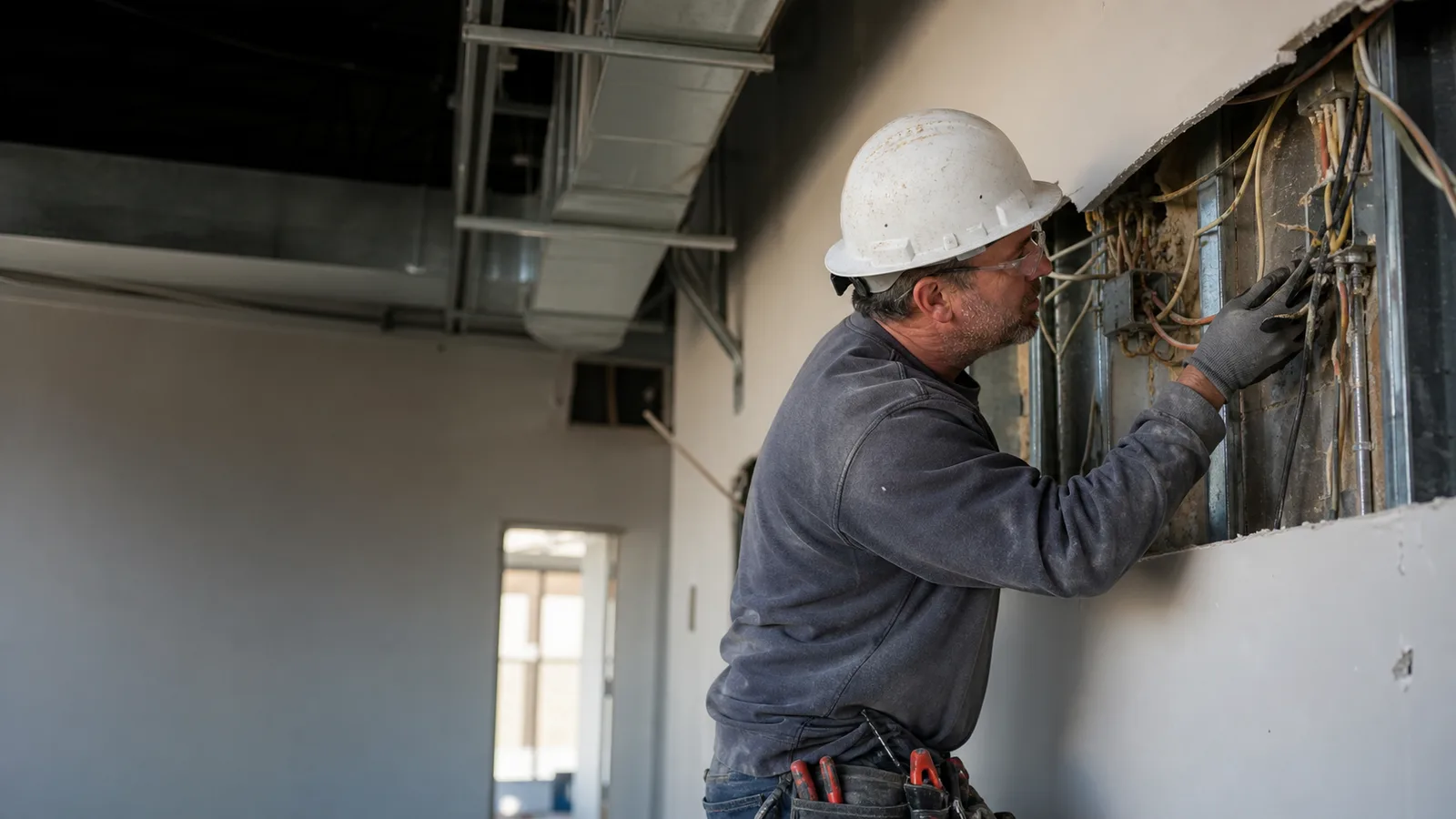
The ceiling tile comes out at 7:14 on a Tuesday and there are two unlabeled energized circuits sitting exactly where sheet E-201 shows clear plenum.
For an electrician, concealed conditions are the one situation where extra work documentation has to be written before the work, not reconstructed after it.
Nobody ever disputes that the crew was there. The dispute is whether anyone can reconstruct what was behind that wall eight months later.
That is the actual problem. The charge was fair — the explanation was missing.
A record that reads 8.77 hrs loses that argument. A record that reads Tue 7:02a–3:48p — opened 2nd flr east corridor ceiling at grid C-4, found existing 3/4in EMT abandoned and two unlabeled energized circuits not shown on E-201; stopped 7:14a, photographed, notified GC super Ray 7:20a ends it.
Same hours, same invoice. One of them is checkable by somebody who was never on the job.
What follows is the whole procedure: what counts, what to capture, what to write, who signs it, and how the hours tie back. It runs on a phone camera, a notes app, and a clipboard.
What Counts as a Concealed Condition on an Electrical Job
A concealed condition is a physical condition hidden in existing construction that either differs from what the contract documents showed, or is so unusual nobody would have priced it. It is not weather, not a material shortage, and not a price increase.
The published guidance on this is written for civil work — rock, soil, groundwater. That is not what an electrician opens up.
The electrical version looks like this:
- Knob-and-tube or cloth-insulated conductors behind a finished wall you are extending into
- Aluminum branch wiring on a circuit the new scope has to land on
- An existing panel with no available spaces, or a bus rating below the added load
- Energized circuits in a wall or ceiling that appear nowhere on the E-sheets
- Abandoned conduit and dead circuits nobody can trace or de-energize with confidence
- No accessible pathway above a hard-lid or plenum ceiling the drawings showed as open
- Conduit routed nothing like the drawings — wrong side of the wall, wrong elevation, crushed, or full
- No equipment ground present on a circuit you are required to extend
- Missing or destroyed firestop at penetrations you have to reopen
- Suspected asbestos wrap or lead in the cavity, which stops the work entirely
- Existing work that code now forces you to correct the moment you touch that circuit
Type I and Type II, in Plain Language
Two kinds of claim, and you are almost always making the first one. Type I means the condition differs materially from what the contract documents indicated. Type II means the condition is unusual in nature and would not ordinarily be encountered in work of that kind.
The federal differing site conditions clause (FAR 52.236-2) uses exactly these two categories, and private contracts borrow the framework.
| Type I | Type II |
|---|
| The test | Differs materially from what the contract documents indicated | Unusual in nature, not ordinarily encountered in this kind of work |
| Electrical example | E-201 shows an empty 3/4in EMT run; the raceway is full of existing energized conductors | An unmarked, undocumented 1950s knob-and-tube branch still live in a 2005 remodel |
| What you must show | What the documents indicated, and what you actually found | That the condition is genuinely unusual for this building type and vintage |
| Difficulty | Easier — the drawing is the baseline | Harder — you are arguing against "you should have expected that" |
| Killer | The condition was shown somewhere in the documents | It was raised at the pre-bid walk, or appears in any contract document |
Both types need the same thing from you: a dated record of what the documents showed, what you found, and when you found it. Type I lives or dies on the sheet reference — write it down every time.
Whose Notice Clock Are You On?
If you are an electrical sub, you are on the GC's clock — not the owner's, and not the number everybody quotes. Your notice window comes from the flow-down clause in your own subcontract, and it is typically shorter, because the GC needs time to make its own deadline upstream.
The 21-day number people still repeat is out of date. A201-2007 said 21 days; AIA A201-2017 §3.7.4, "Concealed or Unknown Conditions," cut it to 14 — notice before the conditions are disturbed and in no event later than 14 days after first observance. That is the prime contractor's clock, running to the owner and architect, and it is two weeks, not three. Yours is shorter still.
| Contract type | Notify whom | Typical window | Where to look |
|---|
| Prime under AIA A201-2017 | Owner and architect | Before disturbing; no later than 14 days after first observance | §3.7.4 |
| Federal prime | Contracting officer | Promptly, and before the conditions are disturbed | FAR 52.236-2 |
| Electrical sub under a flow-down | The GC, in writing | Whatever your subcontract says — usually much shorter than the prime's 14 days | The notice and claims article of your own subcontract |
| Residential or small commercial, one-page proposal | The homeowner or property manager | No clause at all — same day, in writing | Nothing to look up; the record is all you have |
Go find the actual number in your own subcontract today, before you need it, and write it on the inside of the job binder. This is a description of common contract language, not legal advice — have your attorney read your real contract.
The last row is the one most 10-to-30-worker shops actually live in. With no clause, there is no deadline to blow — and no clause to point at either, which makes the contemporaneous record the entire case.
Do Not Fix It First
The clause says notice comes before the conditions are disturbed. The trade instinct is to solve it while the wall is already open, because coming back costs a mobilization.
Fixing it first destroys the evidence and, under most contracts, damages the claim. Ten minutes of documentation protects the whole day.
Stop at the discovery. Photograph, write, notify, and get direction — then work.
If the condition is a safety issue — live conductors in an unexpected place, no ground, suspected asbestos — make it safe, document what you did to make it safe, and note the time you did it. Nobody is asking you to leave a hazard open for the paperwork.
The Six Things to Capture in the First 90 Seconds
Everything a concealed-conditions claim needs is available in the first minute and a half, and almost none of it is recoverable later.
- The clock time of discovery. Not "Tuesday morning."
7:14a. The notice clock starts when your electrician sees it, not when the office hears about it. - The exact location. Grid or column line, floor, room number, elevation. "East wing" is not a location; "2nd floor, east corridor, grid C-4, above ceiling at 9'-6"" is.
- What the drawings showed instead. Sheet and detail number —
E-201,E-2.1 detail 4,panel schedule LB. This is the Type I baseline and it takes four seconds to write. - The condition, in nouns. Conductor type, gauge, insulation, raceway size, energized or not, how many circuits, what it feeds if you know.
- Photos before anything is disturbed. Wide shot showing where you are in the building, medium shot of the opening, tight shot of the condition, and one frame with a tape measure or a room number visible. Phone photos carry a date and time in the file itself. Send the originals, not screenshots, and not photos re-saved through an editing app — that is what strips the timestamp.
- Who you told, when, and how.
Notified GC super Ray Alvarez 7:20a, in person, confirmed by text 7:24a. A text message is a timestamped written notice, which is why it beats a hallway conversation.
The Field Note: Weak Versus Strong
The note is the spine of the whole thing. It is what the GC, the owner, and eventually your own bookkeeper read, and it takes about twenty seconds longer to write the strong one.
| Weak — loses the argument | Strong — ends it |
|---|
Give each discovery a number — CC-01, CC-02 — the first day it happens. Every note, ticket, photo folder, and invoice line after that carries the same number, and eight months later the whole thing reassembles in about a minute.
If your crew struggles with what to put in the box, the pattern in what to write on a timesheet is the same one used here: time in, time out, where, what, and what changed.
Segregating the Extra-Work Hours from Base Contract Hours
Entitlement and quantification are two different fights, and subs lose the second one more often. Winning "yes, that was a concealed condition" and then getting the number cut is the normal outcome when the hours behind it are not separated.
From the first day of the discovery, split the day. One line for base contract work, one line for the concealed condition, per person, per day.
Make CC-01 its own job or its own line item in whatever you already use — a separate row on the paper sheet is enough. What matters is that it never gets mixed back into the base contract total.
Example arithmetic: two journeymen work an 8.5-hour day. Each spends 6.5 hours on CC-01 and 2.0 hours on base contract rough-in. At a $96/hr T&M rate: 13.0 hours × $96 = $1,248 of labor on CC-01 that day, and 4.0 hours stay on the base contract. Run the same split with your own crew size and your own T&M rate.That split is also what survives an audit. If the GC pulls payroll and the extra-work hours plus the base hours do not equal what you paid the man that day, the whole ticket comes into question.
There is software for the note-against-the-hours half — FieldTimesheet captures a free-text note at clock-out and prints a customer-facing packet with date, who, what was done, hours, bill rate and amount — but it does not hold photos, signatures, or cost codes, so the paper discovery sheet still carries that half. A clipboard and a spreadsheet do this job fine; the discipline is the part that matters. More on splitting and presenting hours is in T&M billing best practices.
When the Superintendent Will Not Sign the Ticket
Submit it anyway, in writing, the same day, and note the refusal on the ticket. An unsigned ticket delivered daily is far stronger than a signed one assembled at the end of the month.
Most refusals happen because the super thinks a signature approves the price. It does not — put a line at the bottom of the ticket that says so:
Signature acknowledges hours worked and work performed on this date. It is not approval of entitlement, price, or schedule impact.
That sentence removes the reason most supers give for refusing — that signing locks in a price. When they still will not sign, email the ticket to the super and the PM the same day with the photos attached, keep sending one every day the work continues, and keep the sent folder.
The daily-record pattern for open-ended extra work is the same one used on force account work — one ticket per day, no batching, no gaps.
The Written Notice, Fill in the Blanks
Notice preserves the right. The ticket proves the cost. The change order converts it to money. Three documents, three clocks — do not treat them as one.
Send the notice the same day, by email, to the person your subcontract names. Copy the PM.
Re: [Project] — Notice of Concealed Condition, [location] — CC-[nn]>
On [date] at [time], [name], our [foreman/journeyman], opened [exact location — floor, grid, elevation] to perform [scope of base contract work]. We encountered [condition, in nouns], which is not shown on [sheet / detail / panel schedule] and differs materially from the conditions indicated in the contract documents.>
Work at that location stopped at [time]. The condition has not been disturbed. Photographs taken at [time] are attached.>
This is notice under [Article/Section of our subcontract, or AIA A201-2017 §3.7.4]. We request written direction before proceeding. Additional labor, material, and any schedule impact will be submitted on daily time-and-material tickets beginning [date].
If the answer comes back verbally — "keep going, we'll sort it out" — reply to it in writing the same day, restating what you were told, who told you, and at what time. A verbal directive you confirmed in writing behaves almost like a written one; a verbal directive nobody wrote down behaves like nothing at all.
The One-Page Discovery Sheet You Can Rebuild Today
Print this as a form and put a stack in every van. Every field exists because it is the thing missing from disputed claims.
- Job name and number · Discovery number (CC-01)
- Date · Time found · Found by (printed name)
- Exact location: floor, grid/column, room, elevation
- Drawing reference: sheet and detail
- What the drawings showed
- Condition found (conductor type, gauge, insulation, raceway, circuits)
- Energized? Y / N · Made safe at [time], how
- Work stopped at [time] · Condition disturbed? Y / N
- Photos taken: count and time
- Notified: name, method, time · Direction received: from whom, time, what
- Hours today on this condition: name, in, out, total (one row per person)
- Material used today
- Signature and printed name of GC or owner rep · Date
- Footer line: Signature acknowledges hours and work performed, not entitlement or price.
What You Hand the Customer When They Push Back
At billing time the concealed condition is one or two lines on an invoice that the customer did not plan on. Handing over a lump sum invites a fight; handing over the reconstruction ends it.
Send a packet, not a number: the date, who was on site, what was found, what was done about it, the hours, the bill rate, and the amount. Attach the photos and the notice email.
That packet is just the field notes typed up in order — which is why the note has to be written on the ladder rather than at the desk. There is a worked sample billing packet showing the layout, and it is the same structure whether it comes out of software or a word processor.
The point of every step above is not to win a lawsuit. Almost none of these ever get near a lawyer. The point is that the customer reads the packet, recognizes the work, and pays it without an argument — which is also the only outcome that keeps the GC calling you next year.