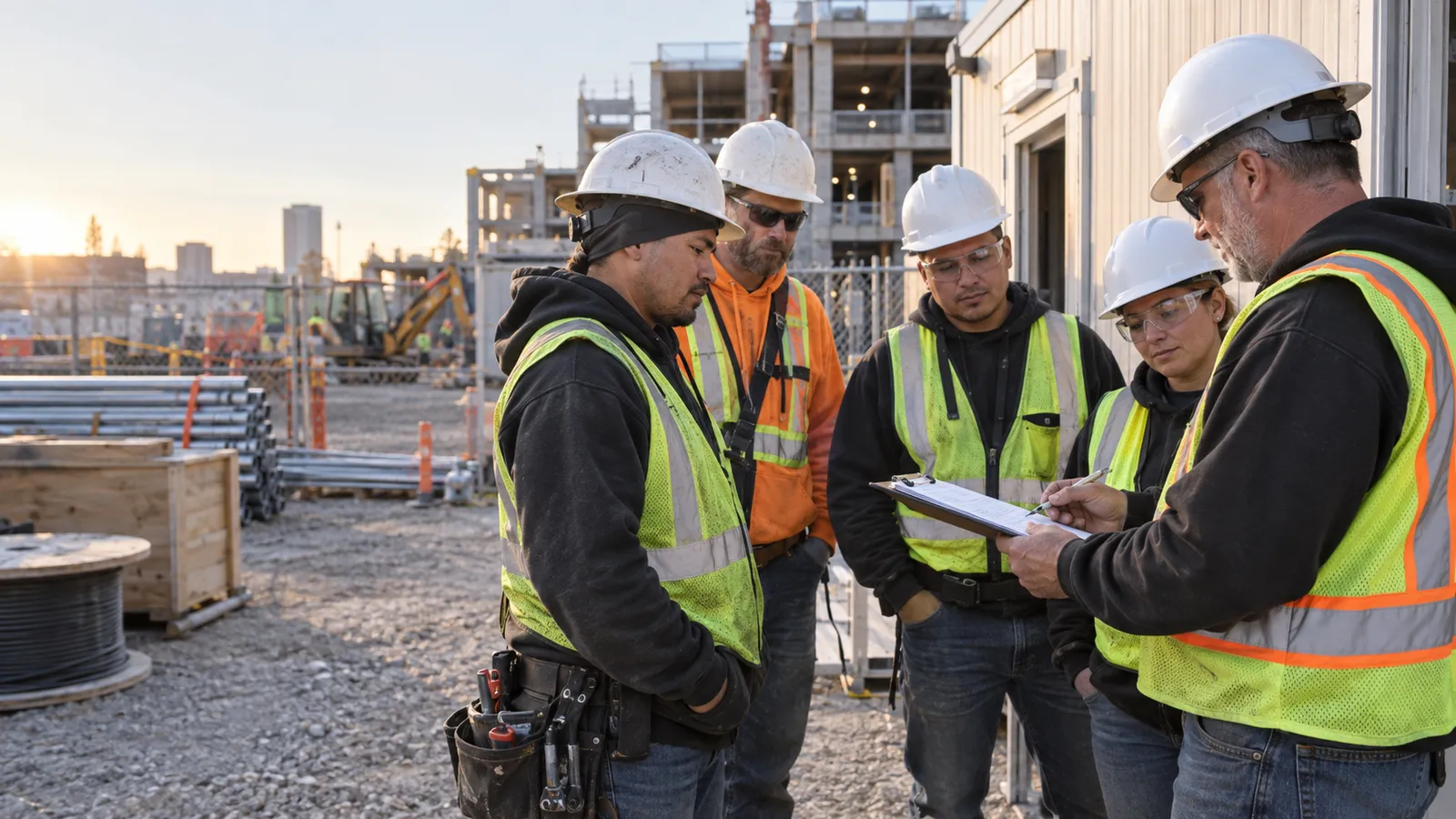
Monday, 7:00 a.m. Six of your electricians are sitting in a job trailer watching the GC's safety video. Nobody has pulled a wire. Nobody will until they finish the quiz, get badged, and walk the site with the superintendent.
That is four hours of labor. When it shows up on a T&M invoice as "Labor, 24.0 hrs," the customer's PM starts asking questions. This guide covers electrical contractor site orientation safety training hours billing: when those hours are billable, what the contract has to say, how to write them down, and how to put them on the invoice so the customer can check them.
The Charge Was Fair. The Explanation Was Missing.
Orientation time is not padding. The GC or owner required it, and your crew could not start work without it.
The dispute starts because the record doesn't say that. "24.0 hrs" on a Monday with no installed material looks like a crew standing around. Compare it with this line:
Mon 9/14, 7:00–11:00a. GC site-specific safety orientation + badging, required per subcontract Exhibit C. 6 electricians. No production work.
The first line invites an argument. The second one answers the question before anyone asks it. The rest of this post is about getting to the second line every time.
Is Site Orientation Time Billable on a T&M Job?
Usually yes, if the contract or work authorization says so up front. If it says nothing, expect a fight. On lump-sum work, orientation is normally part of your bid price and is not billed separately.What decides it:
| Contract type | Is orientation billable? | What to check |
|---|
| T&M / cost-plus | Usually, if the contract defines billable labor broadly or names orientation outright | The definition of "billable labor" or "work"; any exclusions for training or safety time |
| Lump sum | No. It belongs in your bid | Site-specific requirements in the bid documents, so you can price them |
| Change order (T&M basis) | Yes, if the change adds new crew or a new site area that requires its own orientation | Whether the CO covers mobilization and site-access time |
| Unit price | Rarely. It is built into the unit rate | Whether there is a separate mobilization or general-conditions line |
| Service / small T&M ticket | Yes, when the customer's facility requires a contractor induction | The signed work authorization |
Look for exclusions. Some subcontracts say training, safety meetings, and "non-productive time" are not billable. If yours does, those hours are overhead and belong in your rate, not on the invoice. Knowing that before the job starts is still worth a lot.
This is general information, not legal advice. Have anyone who reviews your contracts look at the specific language.
What Contract Language Makes Orientation Hours Billable?
Orientation hours are billable when the contract names GC- or owner-required orientation and states that the time is billed at the T&M labor rate. Get it in writing before the first orientation, not after the invoice gets questioned.Wording you can adapt for a T&M work authorization or subcontract rider:
"Time spent by Contractor's personnel attending Owner- or General Contractor-required site orientations, safety inductions, badging, drug screening, and site-specific training is billable labor at the rates in Schedule A. This includes orientation for personnel added to the project after mobilization and any refresher or re-badging the Owner or GC requires."
If you can't get that in the contract, put this in the bid or proposal as a stated assumption:
"Proposal assumes site orientation of no more than [2] hours per worker. Additional required orientation, re-orientation, or training will be billed as T&M at the rates above."
The T&M Billing Backup Kit includes a T&M work authorization form you can use for this. It's free, and you don't need to sign up for anything.
Do You Still Pay the Crew for Orientation Time?
Generally yes: under the federal Fair Labor Standards Act, orientation your crew is required to attend during work hours is paid work time, whether or not you can bill the customer for it.The U.S. Department of Labor's rule (29 CFR 785.27) treats training as unpaid only when all four of these are true: it happens outside normal hours, it is voluntary, it is not directly related to the job, and no productive work is done. A GC-mandated orientation fails the "voluntary" test on its own.
State law and prevailing wage or union agreements can add requirements. Check with your payroll provider or labor attorney for your situation. For billing purposes, the takeaway is simple: you are paying for this time either way, so write it down either way.
What Does an Electrical Site Orientation Usually Cover?
Most GC or owner orientations take 1–4 hours and cover site safety rules, credential checks, badging, and electrical-specific topics like lockout/tagout and arc-flash permits. If you know what's coming, you can estimate the length and put it in the bid.| Item | Typical time | Notes |
|---|
| General site safety video and quiz | 30–90 min | Site rules, PPE, emergency routes, reporting |
| Credential check at the gate | 15–45 min | OSHA 10/30 cards, licenses, ID. Some states and owners require OSHA 10 for site access |
| Badging and photo ID | 15–60 min | Often done one at a time, so it grows with crew size |
| Lockout/tagout program review | 20–60 min | The site's LOTO procedure and lock rules, which may differ from yours |
| NFPA 70E / arc flash and energized-work permit process | 20–60 min | How the owner handles energized-work permits and approach boundaries |
| Drug screen (if required) | 30 min–half day | Sometimes off site, which adds travel |
| Site walk with the superintendent | 30–60 min | Laydown areas, access, and which areas are energized |
Keep this separate from your own company's safety training. NFPA 70E calls for electrical safety retraining at intervals of no more than three years. That is your obligation as the employer. It is overhead unless a contract says otherwise.
How Do You Record Orientation Hours So They Hold Up?
Log orientation as its own time entry, apart from production work, with a note that names the requirement, who required it, who attended, and how long it took. Those four facts are what end the dispute.What each entry needs:
- Date and actual start/stop times. Write 7:00–11:00a, not "4 hrs."
- What it was. "GC site-specific safety orientation + badging."
- Who required it. "Required by [GC] per subcontract Exhibit C," or "required by owner facilities for contractor access."
- Who attended. Crew names or a headcount, matched to the individual time entries.
- That no production work happened. Say it outright so nobody wonders.
- Proof from the other side. Keep the GC's sign-in sheet or badge-issue list. Take a photo if nothing else. That is the customer's own record agreeing with yours.
If your crew already clocks in on their phones, the clock-out note does the job. FieldTimesheet, for example, asks "what did you work on?" at clock-out, and that note carries onto the printed billing packet. It has no separate orientation or training category. Each worker clocks themselves in, and the note is what identifies the time.
Getting the crew to write it down
The hard part is rarely the owner. It's getting six people to type something at the end of a morning in a trailer.
Make it one sentence, and give the foreman the wording before anyone clocks out: "Write GC orientation + badging, [site name]." When everyone uses the same phrase, the entries match and the invoice line writes itself.
It also protects the crew. When the entry says what they were doing, nobody can later claim they were standing around.
How Do You Show Orientation Time on the Invoice?
Put it on its own line, apart from production labor, with the date, times, headcount, reason, and the contract clause. Bill it at the bill rate. Never show your cost rate or your margin.Before and after:
Example (6 electricians × 4.0 hrs × $95/hr bill rate; swap in your own numbers):| Invoice line | Likely customer reaction (illustrative) |
|---|
| Before | Labor — 9/14 — 24.0 hrs — $2,280.00 (example: 6 workers × 4.0 hrs × $95) | "What did six guys do all Monday morning?" |
| After | Site orientation + badging (GC-required, Subcontract Exhibit C) — Mon 9/14, 7:00–11:00a — 6 electricians × 4.0 hrs — 24.0 hrs @ $95.00 (example rate) — $2,280.00. GC sign-in sheet attached. | Checks the sign-in sheet. Approves. |
Behind that line, attach the backup: one row per worker with name, date, times, hours, and the note. Want to see how that looks as a finished document? The sample billing packet is an annotated example with no signup.
For more on structuring T&M backup in general, see T&M billing best practices.
Worked Example: One Job, Two Orientations
Example arithmetic. Swap in your own crew size, hours, and bill rate.Inputs: a 6-person crew, a 4-hour GC orientation on day one, and a bill rate of $95/hr. Three weeks in, 2 new electricians rotate onto the job and each needs a 2-hour re-orientation.
| Event | Workers | Hours each | Total hours | Bill rate (example) | Line amount |
|---|
| Initial orientation + badging | 6 | 4.0 | 24.0 | $95 | $2,280 |
| Re-orientation, new crew members | 2 | 2.0 | 4.0 | $95 | $380 |
| Total | 28.0 | $2,660 |
The re-orientation row is the one most likely to be questioned, because it comes weeks after mobilization. That's why the contract language above names "personnel added to the project after mobilization." It's also why the note should say "new to site, required re-orientation."
If you'd like to see what a disputed line costs in time and write-offs, the invoice dispute calculator lets you plug in your own numbers.
Keep Orientation Hours Out of Your Production Numbers
Even when orientation isn't billable, keep it out of your production labor. If you don't, the job cost report will say the first week of rough-in took 24 hours longer than it did, and your next bid inherits that error.
A simple approach: total orientation hours per job separately, from the notes. At closeout you'll see how many hours each GC's site requirements actually took. Use that the next time that GC sends a bid invite. For more on this, see job costing for electricians.
Checklist: Before, During, After
| When | Do this |
|---|
| Bid / contract | Ask the GC how long orientation runs and whether re-badging applies. Add the billable-orientation clause or a stated bid assumption. |
| Before day one | Give the foreman the exact note wording. Confirm every worker's OSHA card and ID are ready. |
| Orientation day | Log actual start/stop times. Get or photograph the GC sign-in sheet. |
| Crew changes | Log each re-orientation as its own entry with "new to site" in the note. |
| Invoice | Put orientation on its own line with the contract clause, headcount, and times. Attach the sign-in sheet and per-worker backup. |
Frequently Asked Questions
Can an electrical contractor bill for GC-required site orientation?
On T&M work, usually yes, if the contract or work authorization defines that time as billable labor. On lump-sum work it belongs in the bid. Read the subcontract for exclusions on training or non-productive time before you invoice.
Do I have to pay my electricians for safety orientation time?
Generally yes. Federal wage-and-hour rules treat required, job-related training during work hours as paid time. State law and labor agreements may add rules, so confirm with your payroll provider or attorney.
How should orientation hours look on a T&M invoice?
Give them their own line, with the date, start and stop times, headcount, hours per worker, the reason ("GC-required"), and the contract clause, billed at your bill rate. Attach the GC's sign-in sheet and a per-worker backup sheet.
What about re-orientation when new crew members join mid-job?
Bill it the same way if the contract covers personnel added after mobilization. Log it as a separate entry that says the worker was new to the site. Otherwise it looks like a repeat charge.
What if my contract says nothing about orientation?
Raise it in writing before the orientation happens. A short email or a signed T&M work authorization that states the time will be billed at contract rates is much stronger than raising it on the invoice.
Is my company's own NFPA 70E or OSHA training billable?
Usually not. Training you provide to meet your own obligations as an employer is typically overhead built into your rates. Owner- or GC-specific training that a particular site requires is different, and it can be billable if the contract says so.
How long does a typical GC site orientation take?
Most run 1 to 4 hours per worker, counting the video, quiz, credential check, badging, and site walk. A drug screen can add half a day. Ask the GC ahead of time and write the number into your bid assumptions.
What proof ends a dispute over orientation hours?
Two records that agree: your time entries, with notes naming the orientation and who required it, and the GC's own sign-in sheet or badge list. It's hard for a customer to dispute a record that matches their own paperwork.