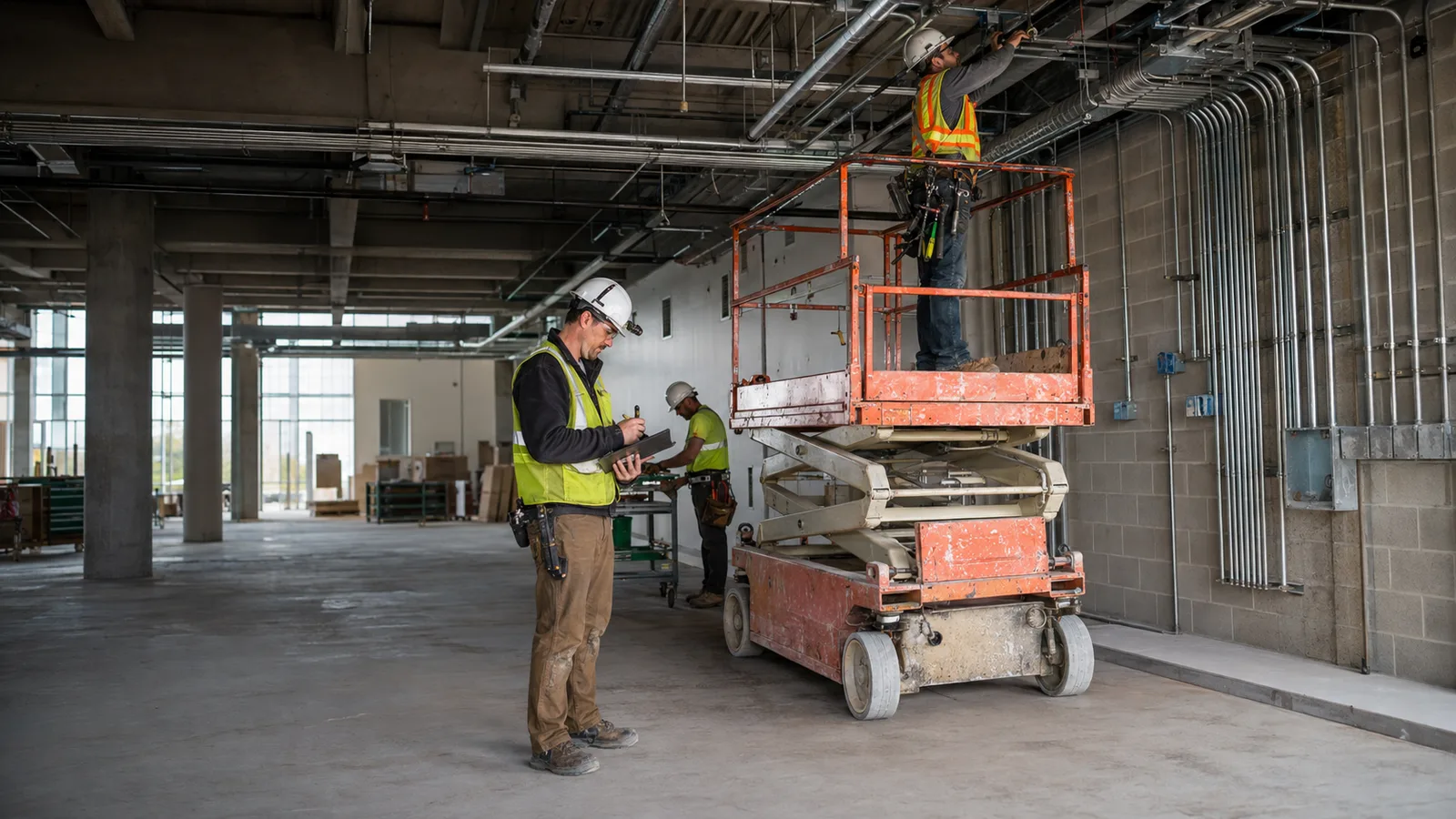
The customer never calls about the whole invoice. They call about one line.
"Scissor lift, 5 days, $1,700. My guy says your crew was only there four days."
An equipment rental charge on an electrical contractor T&M invoice is the one line with no person attached to it. Labor has a name and a timesheet behind it. Material has a supply house invoice with part numbers on it. The lift has a number, a dollar amount, and nothing on the page that says what it did.
Two things are wrong with that line, and only one of them is arithmetic. Five days on rent should have been billed on the week rate, which takes the machine charge from $1,700 to $915. And the customer is right about the crew: they were there four days, because on the fifth the GC shut the area down and the lift sat. Fixing the arithmetic gets you to a defensible number. Fixing the explanation is what makes the number survive.
What follows is the complete rule set for that line: what it has to prove, how to pick the rate basis, what to do with idle days, how to handle furnished equipment, delivery, fuel and damage waiver, and how to make the rental days and the labor days tell the same story. None of it needs software. You can fix your rental billing Monday morning with a spreadsheet and a clipboard.
What an equipment rental charge on a T&M invoice has to prove
An equipment line has to prove four things: the machine was needed for the work and was not already being furnished to you, it was on rent on exactly the days billed, the rate basis is the correct one, and every pass-through charge is itemized instead of buried in the rate.
Everything else in this post is a way of proving one of those four.
Here is what a customer is really asking when they push back on a rental line, and what answers each question.
| What they ask | What answers it | Where it comes from |
| "Why did this job need a lift at all?" | The task that required it, in the crew's words | Daily field report, or the work description on the labor backup |
| "Wasn't the GC furnishing a lift for that floor?" | Written confirmation, dated before you ordered the machine, that they were not | Email or field ticket from the GC's superintendent |
| "You billed 5 days. Were you there 5 days?" | On-rent and off-rent dates with the crew days beside them | Rental contract, delivery and pickup tickets, timesheets |
| "Where did this rate come from?" | The yard's rate card, or the agreed owned-equipment rate | Rental invoice, or the rate schedule named in your contract |
| "What is this extra $192?" | Delivery, pickup, fuel and waiver shown as their own lines | The rental invoice, itemized |
| "Did you mark this up?" | The markup basis, stated before the job started | The signed T&M authorization or the contract clause |
One boundary before the rules. This is the rental and major-equipment line: scissor and boom lifts, a trencher or directional bore for an underground feeder or service run, a core drill for floor and wall penetrations, a cable tugger with its reel stands and reel trailer, a hydraulic bender, and temporary generators with spider boxes. It is not the small tools and consumables charge, which is where hand benders, hammer drills, meters, knockout sets and bits belong. And it is not material markup.
The test for which line a machine goes on: if it comes off a rental invoice, or it carries a unit number in your own yard, it belongs here. If it rides in the van and nobody logs it, it belongs in small tools. Three different lines, three different sets of backup. A core drill that shows up as a rental one week and inside the small-tools percentage the next is a double charge, and the customer will eventually find it.
Rented from a yard vs. a machine you own: two different lines
A third-party rental is a pass-through. There is an invoice from the yard with dates and a rate printed on it, and your job is to attach it and match its dates to the work.
Your own scissor lift has no invoice. Nobody else set that rate, so the rate is an assertion until the customer agreed to it in writing.
| Item | Rented from a yard | Owned by you |
| Rate source | The yard's rate card, printed on the invoice | A rate you set in the authorization, or a named published schedule |
| Backup document | Rental invoice, delivery and pickup tickets | Your equipment log plus the agreed rate, in writing |
| When the rate gets settled | It settles itself | Before the machine goes on the truck |
| Markup | Whatever the contract clause allows | Usually capped at local commercial rental rates |
| Most common rejection | Rental dates do not match crew days | "We never agreed to that rate" |
On federal construction work, FAR 31.105(d)(3) points at predetermined schedules of construction equipment use rates or at actual cost, not at a number you pick. The schedule it points at is the Construction Equipment Ownership and Operating Expense Schedule published by the U.S. Army Corps of Engineers, EP 1110-1-8. Outside federal work, many state DOTs adopt the Rental Rate Blue Book for force-account equipment instead. If the customer is public, ask which of those two governs before you invoice, because the answer changes the rate you are allowed to bill.
Deriving a rate for a machine you own
If no schedule governs, meaning the job is private and the contract names neither book, build the rate from your own numbers and put it in the authorization before the job starts.
Ownership cost per hour equals purchase price minus expected salvage, divided by useful life in hours. Add maintenance, wear parts and insurance per hour. Add fuel or charging per hour.
Example arithmetic with placeholder inputs, not market rates. Replace every number with yours: a machine bought for $32,000, salvage $6,000, useful life 6,000 hours gives $4.33 per hour of ownership. Add $2.50 per hour for maintenance and insurance and $1.20 per hour for energy, and you are at $8.03 per hour, or about $64 for an eight-hour day.
Then check that against what the local yard charges for the same machine. If your number lands higher, you will lose that argument, so bill the lower one and say which one you used.
Picking the rate basis: the day, week and month rate cliff
Rental yards price in day, week and four-week blocks, and the blocks are not multiples of each other. A week normally costs far less than five days, so day-counting a long rental produces a number the customer can beat with one phone call to the yard.
The rule: whenever days times the day rate exceeds the next block up, bill the block.
Example arithmetic with placeholder rates. Use the numbers on your own rental card: day $340, week $915, four weeks $2,450.
| Time on rent | Day-count arithmetic | Correct basis | Billed |
| 2 days | 2 x $340 = $680 | Day rate applies | $680 |
| 5 days | 5 x $340 = $1,700 | Week rate is lower | $915 |
| 9 days | 9 x $340 = $3,060 | 1 week plus 2 days: $915 + $680 | $1,595 |
| 26 days | 26 x $340 = $8,840 | Four-week rate | $2,450 |
Then show the basis on your own line. "Week rate, 1 week" survives review. "5 days" invites a recount.
Idle days, standby days, and the day the floor got shut down
You bill the days a machine sat when it was on rent and the reason it sat is documented on that day. The rental clock runs on possession, not on use. What loses the argument is billing an idle day and saying nothing about it.
There are three different idle days and they are not defended the same way.
Weekend and overnight days inside a rental period are already inside the rate. A week rate includes the Saturday, so bill the block and the question never comes up.
Days the machine sat because the site was not ready are billable, and the note has to say why: another trade in the area, an inspection hold, a pour the GC called, a utility locate that had not cleared before the trencher could open the ditch. That reason belongs in the daily report on the day it happened, in one line.
Days the machine sat because your crew went to a different job are not the customer's charge. Off-rent it or absorb it. Billing those is what teaches a customer to audit every rental line you ever send them.
There is also a real cost the day rate hides. When a machine is on rent and blocked, a return trip plus re-delivery can cost more than the standby days, and on a trencher or a directional bore the mobilization is the expensive half. Say that in writing at the time and let the customer choose.
Delivery, pickup, fuel, damage waiver and tax
Itemize every one of them. A rental total with the extras rolled in reads like a padded rate, which invites the exact question you are trying to avoid.
| Charge | What it is | How to bill it | What proves it |
| Delivery or mobilization | Getting the machine to the site | One line, once per rental | Delivery ticket with date and address |
| Pickup or demobilization | Getting it back to the yard | One line, once per rental | Pickup ticket with date and time |
| Fuel or refuel charge | The yard refills it and bills you | Pass through at cost, note the gallons | The fuel line on the rental invoice |
| Damage waiver | Optional coverage, charged as a percent of the rental, typically in the 10 to 15 percent range on a yard's card | Bill it only if the contract allows it, and show the percent and the base | The percent printed on the rental invoice, plus the contract clause |
| Environmental fee | The yard's flat surcharge | Pass through, itemized | The rental invoice |
| Minimum charge | The four-hour or one-day floor printed on the yard's rate card | State the minimum on the line so a two-hour use does not read as a full day | The minimum-charge line on the rate card |
| Sales tax | Tax the yard charged you on the rental | Varies by state, ask your accountant | The rental invoice |
Sales tax on rentals is genuinely state-specific, and it can turn on whether the work counts as a capital improvement. Do not guess. Ask your accountant once, write the answer down, and apply it the same way every job.
Markup on rentals: read the clause before you bill it
Whether you can mark up a rental is decided by the contract, not by custom. Find the sentence in your T&M agreement that covers equipment and follow it exactly.
| What the contract says | What to bill | What to show the customer |
| "Rental equipment at cost" | The rental invoice total, no markup | The rental invoice, attached |
| "Cost plus X percent" | Invoice total plus that percent | The invoice, the percent and the arithmetic |
| Silent on equipment | Bill at cost, or get the markup agreed in writing before you rent | Whatever you agreed, in the authorization |
| A named schedule, such as EP 1110-1-8 or the Rental Rate Blue Book | The scheduled rate for the hours used | The schedule name and edition, and the hours claimed |
Disclosed markup gets negotiated once. Discovered markup gets your whole invoice re-read.
Name the equipment in the authorization before it goes on the truck
This is the cheapest fix on the list. A work authorization that covers labor rates and says nothing about equipment is the reason rental lines get struck outright.
Start with the question that kills the whole line on commercial work: before you order a machine, confirm in writing whether the GC is furnishing one for the area and floor you are working. A rental billed against a lift that was already furnished does not just get struck, it gets the rest of your invoice audited, because you have handed the customer a reason to look at everything else.
Then get one line in writing from whoever authorized the work, before the machine is ordered:
"Second-floor east wing feeder pull requires a 26-ft electric scissor lift. GC confirms no lift furnished for the east wing on this floor. Lift rented by us, billed at rental cost plus 10 percent, estimated 4 to 5 working days. Delivery and pickup billed at cost."
A text message counts. An email counts. A photo of a signed field ticket counts. What does not count is a verbal "get whatever you need" three weeks before the invoice.
The free T&M Billing Backup Kit has a work authorization form and a daily field report you can print, no email required. Add an equipment line and a furnished-or-rented line to the authorization, and the argument moves from the invoice back to the day the machine was ordered, which is where it is winnable.
The equipment log: ten columns, one row per machine per day
This is the artifact. Build it in a spreadsheet Monday and it is the whole difference between a rental line that reads and a rental line that gets recounted.
One row per machine per day. The columns:
- Date
- Job and area
- Equipment and unit number
- Rental invoice or ticket number
- On rent or off rent
- Days or hours claimed
- Rate basis: day, week, month, or owned hourly
- What it was used for, meaning the task and not the words "in use"
- Crew on site that day
- Amount
Filled in, one week looks like this.
| Date | Equipment | On or off rent | Basis | What it was used for | Crew on site |
| Mon 6/2 | 26-ft scissor, unit 4412 | Delivered 7:15a | Week | Set feeder hangers, 2nd floor east | Ruiz, Delgado |
| Tue 6/3 | 26-ft scissor, unit 4412 | On rent | Week | Pulled feeders, east wing | Ruiz, Delgado |
| Wed 6/4 | 26-ft scissor, unit 4412 | On rent | Week | Pulled and terminated feeders 12 through 18 | Ruiz, Delgado, Voss |
| Thu 6/5 | 26-ft scissor, unit 4412 | On rent, idle | Week | Idle. GC shut east wing for concrete pour | None on site |
| Fri 6/6 | 26-ft scissor, unit 4412 | Off rent 2:10p | Week | Terminated RTU-3 feeders, machine picked up | Ruiz |
Reconcile rental days against labor days before the invoice goes out
Do this every time, before the invoice is sent: put the rental days and the crew days side by side and make sure every difference has a written reason. The customer runs this arithmetic in their head in about four seconds.
Any date with a rental day and no crew hours needs a sentence. Any date with crew hours and no rental day is fine and needs nothing.
One class of rental is the exception, and it is one electrical contractors bill routinely. A temporary generator or a temp distribution rig is on rent and consuming fuel around the clock with nobody on site, because the temp service and the site lighting stay energized over nights and weekends. Possession-based rentals like that reconcile against a runtime or fuel log and the dates the temp service was energized, not against crew days. Say which basis the line uses on the line itself, or your own reconciliation rule will flag legitimate days as suspect: "Temp generator, energized 6/2 through 6/27, runtime log attached" answers the question before it gets asked.
Example arithmetic using the scissor lift week above with placeholder rates: week rate $915, delivery $85, pickup $85, one fuel charge $22, five days on rent against four crew days. The line bills at $1,107 with the week basis shown, and the one crewless day carries the shutdown note.
This is the same thing that makes the labor line hold up. A timesheet that says 8.77 hours survives payroll and loses a dispute. A record that says "Thu 7:02a to 3:48p, pulled and terminated circuits 12 through 18, second-floor east wing" ends the argument, and it is also what makes Thursday's lift day obvious.
The equipment line and the labor line have to tell the same story on the same days. That is the entire trick, and it costs one sentence per worker per day.
Most shops do this with a daily field report and a spreadsheet, and that is genuinely enough. If you would rather collect the labor half on phones than on paper, FieldTimesheet captures the hours plus a "what did you work on" note per person per day and prints a customer-safe billing packet from them. It does not track equipment, rentals or rates, so the equipment log stays yours either way.
What the finished rental line looks like
Same job, same week, same total. The only variable is whether the line carries its own explanation.
The $1,700 line at the top of this post had two defects. Fix the rate basis and you get to the right number, $1,107. Here is that corrected number stated two ways.
Loses the argument:
Equipment rental, 5 days, $1,107
Ends it:
- 26-ft electric scissor lift, unit 4412 (rental invoice 88214 attached)
- On rent Mon 6/2 7:15a, off rent Fri 6/6 2:10p
- Billed at week rate $915. Five days at the day rate would have been $1,700
- Delivery $85, pickup $85, fuel $22, itemized at cost
- Lift rented by us. GC confirmed 5/29 no lift furnished for the east wing
- Used Mon through Wed and Fri for the second-floor east wing feeder pull
- Idle Thu. GC shut the east wing for a concrete pour, see daily report 6/5
- Total $1,107
What to send when the customer challenges the rental line
Send four documents, in this order, in one email, with no argument in the body.
- The rental yard's invoice for that machine and that period
- The delivery and pickup tickets, with times
- The equipment log rows for those dates
- The labor backup for the same dates, with the work descriptions
No defense, no tone. The documents either agree with each other or they do not, and if you kept the log, they do. Here is what a full backup packet looks like, annotated and ungated.
If the argument is already a month old and you are deciding whether to discount or dig in, run the numbers on the dispute with your own figures before you answer.
The Monday morning version
Seven things, none of which cost anything.
- Confirm in writing whether the GC is furnishing a lift for your area before you order one
- Add an equipment line to your T&M authorization form and stop ordering machines without one
- Start an equipment log with the ten columns above, one row per machine per day
- Write the reason on every idle day, on the day it happens
- Check the rate basis on every rental invoice against the day, week and month cliff
- Itemize delivery, pickup, fuel and waiver instead of folding them into the rate
- Reconcile rental days against crew days before the invoice leaves, every time, and note where a temp-power line reconciles against a runtime log instead
Frequently asked questions
Can I mark up an equipment rental charge on a T&M invoice?
Only if the contract allows it. Cost-plus language often caps or excludes markup on rentals, and a markup the customer discovers instead of one you disclosed is what turns a single line into a full audit. If the agreement is silent, get the percent agreed in writing before you rent.
Do I bill the customer for days the rented equipment sat idle?
Yes, when the machine was on rent and the reason it sat is documented that day, such as a GC shutdown, another trade in the work area, an inspection hold, or a utility locate that had not cleared. No, when it sat because your crew was working somewhere else. That day is yours to absorb.
The GC was furnishing a lift. Can I still bill the one I rented?
Usually not, and it is the fastest way to lose the whole equipment line. Confirm in writing before you order the machine whether a lift is being furnished for your area and floor, and if you rent anyway for a documented reason, such as the furnished machine being committed elsewhere on the days you needed it, get that reason agreed in writing at the time rather than explaining it at invoice review.
Can I bill for my own scissor lift, or only for equipment I rent?
You can bill for equipment you own on most T&M agreements, but the rate has to be agreed before the work, because there is no third-party invoice to point at afterward. Either name the schedule that governs, meaning the Corps of Engineers schedule EP 1110-1-8 on federal work or the Rental Rate Blue Book where a state DOT adopts it, or put your hourly or daily rate in the signed authorization.
Does the rental yard's invoice have to go to the customer?
On a cost or cost-plus rental line, expect to attach it. Plenty of owners and GCs will not release payment on a rental charge without it. If the rate is a scheduled or agreed owned-equipment rate instead, attach the equipment log with the delivery and pickup tickets.
Should delivery and pickup be separate lines or built into the rental rate?
Separate. They are one-time charges, and folding them into a per-day rate makes your day rate look inflated against the yard's published card, which is the first number a customer checks.
What if I billed 5 rental days but my crew was only on site 4 days?
Then the extra day needs a written reason from the day it happened, or it comes off the invoice. This is the most common reason a rental line gets struck, and one line in a daily report prevents it entirely. The exception is possession-based equipment such as a temporary generator, which runs with nobody on site and reconciles against a runtime or fuel log rather than crew days.
Is sales tax on an equipment rental billable to my customer?
It depends on your state, and sometimes on whether the work counts as a capital improvement, so ask your accountant once and then apply the answer consistently. What you can always do is show the tax the yard charged you as its own line rather than folding it into the rate.
How long should I keep rental invoices and equipment logs?
At least as long as the audit or records clause in your contract requires. Three years after final payment is common on public and cost-plus work. Scan delivery and pickup tickets the day they arrive, because those are the documents that go missing first.