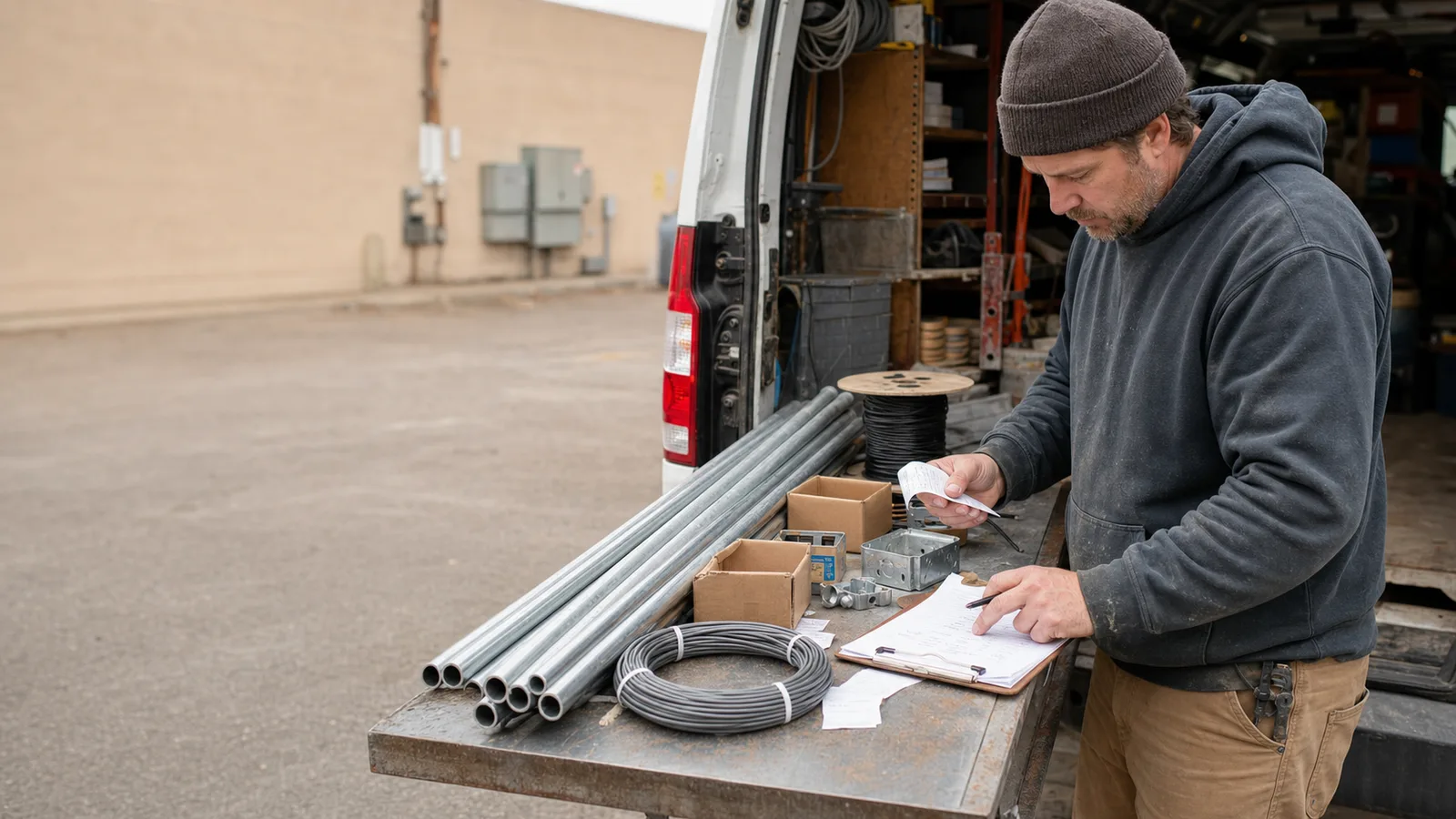
The customer has the T&M invoice on his desk. He is not arguing about the work — he watched the crew do it.
His finger is on the material total. "Why is a $220 panel billed at $297.50?"
Electrical contractor material markup on a T&M invoice is ordinary, defensible practice. The published guides that quote a number land between 5% and 40%.
The percentage is almost never what loses that conversation. The line item he can't reconstruct is.
The charge was fair. The explanation was missing.
What follows is the whole method: how to read the published ranges, the markup-versus-margin arithmetic, what belongs inside the word "cost," the clause to sign before the first day, how to write a material line a customer can trace, how to handle wire nuts and truck stock, and exactly what to attach when he asks. None of it requires buying anything.
What Electrical Contractors Charge for Material Markup
The trade pricing guides that put a number on material markup land in a band running roughly 5% to 40%.
Treat that band as convention rather than survey data. It is a range repeated across trade publishing, not a measured distribution of what contractors actually bill, and nobody outside your office can tell you what your percentage should be. Where you land inside it comes down to three things you can measure yourself: what procurement actually costs you, how much warranty exposure the part carries, and what the contract on that job allows — which on plenty of jobs sets the number for you regardless of what you would have picked.
What the markup pays for is the same everywhere: someone drives to the supply house, someone eats the will-call wait, someone stocks it on the truck, someone handles the return and the restocking fee, someone carries the money until the invoice gets paid, and someone warranties the part when it fails in year two.
That is the case you make out loud. The rest of this post assumes you have picked a number and now have to put it on a bill.
Markup Is Not Margin, and the Gap Shows Up on the Invoice
A 25% markup on cost is a 20% margin on the billed price. Markup is figured on what you paid. Margin is figured on what the customer paid.
Worked example, inputs visible: a 200A panel at a supplier net cost of $220, plus $18 freight, gives a loaded cost of $238. At a 25% markup, the billed price is $238 × 1.25 = $297.50.
Gross profit on that line is $59.50. As a share of the $297.50 the customer paid, that is 20.0%.
| Markup applied to cost | Resulting margin on the billed price |
|---|
| 10% | 9.1% |
| 15% | 13.0% |
| 20% | 16.7% |
| 25% | 20.0% |
| 30% | 23.1% |
| 35% | 25.9% |
| 40% | 28.6% |
If you are working from a target margin instead, divide rather than multiply: billed price = cost ÷ (1 − target margin).
Worked example, on a different item so the two calculations stay separate: a 100A disconnect at a $186 loaded cost, priced to a 25% target margin, is $186 ÷ 0.75 = $248.00 — the same as a 33.3% markup.
| Target margin | Divide cost by | Same as a markup of |
|---|
| 10% | 0.90 | 11.1% |
| 15% | 0.85 | 17.6% |
| 20% | 0.80 | 25.0% |
| 25% | 0.75 | 33.3% |
| 30% | 0.70 | 42.9% |
| 35% | 0.65 | 53.8% |
Run those with your own cost and your own target. The point is that a job priced to a "25%" that meant margin but got billed as a 25% markup lands at a 20% margin — five points light, every line, every job. The same arithmetic drives the labor side of a job — see job costing for electricians for the hours half.
What Counts as "Cost" Before the Markup Goes On
"Cost" means whatever your contract says it means. If the contract is silent, the customer gets to argue for the narrowest reading, and he is not wrong to try.
Define these in writing, before the job, in the T&M authorization:
- Supplier net price or list price. Electrical supply pricing runs on columns and multipliers. Say which price the markup applies to.
- Freight and delivery. In or out of cost. If it is in, it gets marked up; if it is a separate line, it usually should not be.
- Sales tax. Sequencing and taxability vary by state and by whether you buy on a resale certificate. Ask your accountant for your state; do not guess on the invoice.
- Restocking fees and return credits. Say plainly that credits flow back to the customer at the same cost basis, less any restocking fee charged by the supplier.
- Rebates and volume discounts. If the contract says "cost," a GC auditor will ask whether cost is net of your annual rebate. Answer it in the clause, not in the argument.
- Wire waste, cut charges, and minimum reel cuts. A 250 ft cut off a 1,000 ft reel comes with a cut charge on many counters. Bill it or absorb it, but say which.
- Equipment rental. Lifts, trenchers, benders and cores are usually a separate rate, not material, and often carry a different percentage.
Material is billed at the Contractor's net invoiced cost from the supplier, including freight and applicable taxes, plus a material markup of ____%. Return credits are passed through at the same cost basis, less any supplier restocking fee. Equipment rental is billed at the rates on the attached schedule and is not subject to the material markup.
How to Write the Material Line So the Customer Can Reconstruct It
A material line survives a challenge when the customer can trace it to three things: a supplier document, a date, and the work it went into. A single number cannot be checked, so it gets treated as a guess.
Here is the same job billed three ways. Inputs: $1,240 in loaded material cost, 25% markup, $1,550 billed.
| Presentation | What the customer sees | Good for | Where it goes wrong |
|---|
| A. Itemized, markup on its own line | Every item at cost, then "Material markup, 25% — $310" | Cost-plus contracts, GC work, anything with audit rights | Puts your cost basis in the customer's hands permanently, on every item |
| B. Category roll-up, percentage disclosed | Three or four category totals at billed price, with "all material billed at cost plus 25% per §4" in the notes | Most private commercial and residential T&M | Categories have to be recognizable, or it reads as a lump sum |
| C. Loaded unit prices, footnote only | Billed prices only, with a footnote that prices include a markup covering procurement and warranty | Service work and small tickets | Feels like a hidden number if the customer learns the percentage later from somewhere else |
All three are honest. Only one thing is not: a percentage the customer discovers after the fact that was never in the signed authorization.
Presentation B, written out, looks like this:
MATERIAL — Riverside TI, Invoice 2214, work performed 3/10–3/12
Panel and overcurrent devices .................... $  625.00
   200A MLO subpanel, (18) 20A 1P, (2) 30A 2P
Feeder and branch conductors ..................... $  675.00
   90 ft 2/0 CU THHN, 1,400 ft #12 CU THHN
Boxes, raceway and fittings ...................... $  250.00
   (22) 4-sq boxes, 210 ft 3/4 EMT, fittings
                                        MATERIAL   $1,550.00

All material billed at Contractor's invoiced cost plus 25%
per section 4 of the T&M authorization dated 3/06.
Supply house invoices 44118, 44203 attached.
Compare that to "Materials — $1,550." Same money. Only one of them can be checked, and the one that can be checked is the one that gets paid without a call.
The Wire-Nut Problem: Consumables and Truck Stock
Bill consumables as a stated allowance disclosed up front, not as a surprise line at the end. Wire nuts, tape, anti-ox, staples, straps, anchors, blades and strut never come with a supplier invoice tied to that job, so a per-item argument is unwinnable.
There are two defensible methods, and both come out of your own purchase history rather than a number off the internet.
Method 1 — percentage of billed material. Worked example with visible inputs: consumables purchased last year, $8,400, divided by total material purchased last year, $210,000, equals 4.0%. Pull both figures from your accounting system and run it for your own shop. Method 2 — per field labor hour. Same $8,400 divided by 6,000 field labor hours equals $1.40 per hour. This one holds up better on jobs where the material is a few big-ticket items and the consumables are driven by hours, not dollars.Pick one. Charging both is how a defensible allowance turns into an argument.
A consumables allowance of ____% of billed material [or: $____ per field labor hour] covers fasteners, wire connectors, tape, anti-oxidant, blades, anchors, strut and similar small materials not separately itemized. No other charge is made for these items.
Truck stock that does carry a real cost — a spool of #12, a box of 4-sq boxes — is material, not consumables. Itemize it at your cost from the purchase order it came in on, with the supplier invoice number.
Where Your Material Markup Is Capped by the Contract
The percentage is not always yours to pick. Read the general conditions before you set it.
- GC change-order clauses. The general conditions, not the subcontract cover sheet, are where an allowable markup on change-order work gets set — often one percentage for your own material and labor and a lower one for work you sub out. Read the clause on the job in front of you. The allowances vary by contract and by which edition of a standard form it was built from, so a number you remember from the last job is not evidence about this one.
- Public works. Public agency general conditions may cap material markup and sub markup outright, and the cap lives in the general conditions rather than the bid form. Find it before you price the change, not after.
- Federal T&M. Under FAR 16.601, the fixed hourly labor rates carry the profit and materials are reimbursed at cost. Material handling costs can be allowable where your accounting practice supports them, but profit on the material itself generally is not. Confirm the terms with the contracting officer before you invoice.
- Owner-furnished material. You did not buy it, so there is no cost to mark up. Charge handling and labor per the contract instead, and say so in the authorization. This is the bullet that bites electrical subs hardest: owner-furnished switchgear or a fixture package shows up short, wrong voltage, or with the wrong trim, and you still have to receive it, stage it, store it somewhere dry, count it against the submittal, and spend a day chasing the balance. Bill that as labor and handling, because none of it is material you can mark up.
- Subcontracted work and rentals. Usually a separate, lower percentage, and often capped separately from material.
Copper Moves: Quote Date Versus Purchase Date
Wire priced in March is not wire priced in June. On a T&M job that runs months, the material cost the customer has in his head is the one you quoted, and the one on the invoice is the one you paid.
Two sentences prevent that whole conversation:
Material is billed at the supplier's price in effect on the date of purchase. Material quotes are valid for 15 days from the date issued.
Keep the dated supplier quote and the dated ticket. When copper moves against you mid-job, the two documents side by side make the increase a market fact rather than an accusation.
The Markup Clause to Put in the T&M Authorization
The sentence that prevents most material disputes gets signed before the first day of work, not written after the invoice lands.
Put all of it in one place, on the authorization the customer signs:
Material. Material is billed at Contractor's net invoiced cost from the supplier, including freight and applicable taxes, plus a material markup of ____%. Material is billed at the supplier's price in effect on the date of purchase. Return credits are passed through at the same cost basis, less any supplier restocking fee. A consumables allowance of ____% of billed material covers fasteners, wire connectors, tape, anti-oxidant, blades, anchors and similar small materials not separately itemized. Equipment rental and subcontracted work are billed per the attached schedule and are not subject to the material markup. Supplier invoices supporting itemized material will be furnished with each billing on request.
Fill in your two percentages, attach your rate schedule, and have your attorney look at it once before it becomes your standard form. Then quote the markup out loud at the walk-through, before anyone signs. A number the customer heard in March is not a surprise in June. More of the same groundwork is in T&M billing best practices.
What to Attach as Backup, and What Stays Internal
Attach what proves the cost and its connection to the work. Keep what is about your business.
Attach: the material backup sheet for the billing period, supplier invoices or counter tickets for anything itemized, and the daily field report covering the same dates. Keep internal: your pricing on other jobs, supplier rebate agreements, what you pay your people, your labor cost rate, and your margin. None of that is responsive to "why is this panel $297.50," and putting it in front of a customer invites a negotiation you did not agree to have.A material backup sheet is ten columns on one page. Set it up once:
| Column | What it proves |
|---|
| Date purchased | The material existed before the work it went into |
| Job / area | It belongs to this job, not the one across town |
| Supplier | An independent third party can confirm it |
| Invoice or ticket # | The customer can match it to the attached document |
| Item and quantity | The count is checkable against the finished work |
| Unit cost | What one of them cost you, before markup |
| Extended cost | Unit cost × quantity — the basis the markup was applied to |
| Markup % | The number in the signed authorization, applied consistently |
| Billed amount | The line that appears on the invoice |
| What it went into | The tie to the day's work — the column that ends the argument |
That last column is the one contractors skip and the one customers actually read:
3/11 · Riverside TI · [your supply house] · inv 44203
      1,400 ft #12 CU THHN @ $0.225/ft · extended cost $315.00
      +25% · billed $393.75
      → branch circuits 12–18, second-floor east wing
Here is the part that carries over from the labor side of the same invoice. Material gets challenged for exactly the reason hours do: the customer cannot picture what he is paying for.
"8.77 hrs" loses an argument. "Thu 7:02a–3:48p — pulled and terminated circuits 12–18, second-floor east wing" ends it. That field note is also what makes 1,400 ft of #12 obviously belong to that day. The labor record explains the material, and the material corroborates the labor.
Which means the real obstacle is not the markup percentage. It is getting anybody on the truck to write down what they did before they drive home. One line at the end of the shift, in their words, is enough — "what did you work on today" answered in a sentence beats a blank timesheet and a perfect spreadsheet.
Paper does it. A daily field report on a clipboard does it. A shared spreadsheet does it. So does a time-tracking app — FieldTimesheet, for one, captures that note at clock-out and prints hours, note and bill rate on a customer-facing packet, though it tracks labor only and has no material, receipt, purchase-order or markup features at all, so the material log stays in your spreadsheet either way. You can see a sample billing packet without signing up for anything.
The blank sheets are free too: the T&M Billing Backup Kit has the daily field report and the labor backup sheet, and the material log above drops in beside them.
When the Customer Questions the Material Charge
Answer once, in writing, with the document attached. Do not negotiate the percentage on the phone, and do not discount before you have shown your work.
- Ask which line. "Material — $1,550" is a general complaint; "the panel" is a question you can answer in four minutes.
- Pull the ticket. Supplier invoice number, date, quantity.
- Pull the field note for the same date. This is what turns a receipt into an explanation.
- Quote the clause back, by section number. Not "that's our standard markup" — "section 4 of the authorization you signed on 3/06."
- Send it as one reply with the attachments. Not a phone call. A phone call leaves nothing behind for the next question.
The panel is on supply house invoice 44118, dated 3/10 — 200A MLO subpanel, our cost $220 plus $18 freight. Section 4 of the signed T&M authorization dated 3/06 provides for material at cost plus 25%, which is the $297.50 on the invoice. It was set and fed on 3/11; that day's field report is attached. Happy to walk the panel with you if that's easier.
Three facts, one clause reference, two attachments, no defensiveness. If a dispute has already gone past this stage, price out what the argument is costing before you decide what to concede.
Monday Morning: One Hour of Setup
- Pull last year's total material purchases and total consumables purchases from your accounting system. Divide. That is your consumables percentage.
- Pick your material markup, and write down in one sentence what it covers. You will say that sentence out loud to customers.
- Paste the material clause above into your T&M authorization form. Fill in both percentages. Send it to your attorney to review.
- Build the ten-column material backup sheet. One tab, one row per purchase.
- Add "what it went into" to the daily field report so somebody actually fills that last column.
- Reprice one open T&M job with the markup-to-margin table. If the number is not what you thought it was, you found it before the invoice went out instead of after.
Frequently Asked Questions
What is a normal material markup for an electrical contractor?The trade pricing guides that quote a number land in a band running roughly 5% to 40%, with the low end associated with competitive-bid commercial work and the high end with residential service. Treat that as convention rather than survey data. Your own number depends on your procurement costs, your warranty exposure and your contract terms, and on many jobs it is capped by the contract regardless of what you would have picked.
Is a 30% markup the same as a 30% margin?No. A 30% markup on cost works out to a 23.1% margin on the billed price. To hit a 30% margin you divide cost by 0.70, which is a 42.9% markup. Mixing the two up is how a job that priced fine comes in flat.
Should the invoice show my material cost, or just the billed price?Both are defensible as long as the markup percentage was disclosed in the signed authorization. Showing cost plus a separate markup line is normal on cost-plus and GC work with audit rights. Billing loaded prices with the percentage disclosed in the terms is normal on service work. What causes disputes is a percentage the customer only finds out about after the invoice.
Do I charge sales tax on my cost or on the marked-up price?It depends on your state and on whether you bought the material on a resale certificate. Some states tax the contractor as the consumer at the point of purchase; others tax the marked-up price billed to the customer. Ask your accountant for your state rather than copying a rule from another jurisdiction.
How do I bill wire nuts, tape and staples on a T&M job?As a disclosed consumables allowance, calculated from your own purchase history and stated in the authorization. Either a percentage of billed material — last year's consumables purchases divided by last year's material purchases — or a flat amount per field labor hour. Pick one method, write it into the contract, and do not also itemize the same items.
Can a customer demand to see my supplier receipts?On a cost-plus or T&M contract with an audit-rights clause, generally yes for the material being billed at cost. Absent that clause it is a negotiation, not an obligation. Furnishing the supplier invoice for the specific item in question usually ends the conversation faster than arguing about whether you had to.
Can a GC or a public-works contract cap my material markup?Yes. Prime contracts and public agency general conditions can set an allowable markup on change-order material and a lower allowance on work you sub out, and the cap lives in the general conditions rather than the bid form — so read the clause on the job in front of you rather than assuming last job's number carries over. On federal T&M work, FAR 16.601 puts the profit in the fixed hourly labor rates and reimburses materials at cost, so profit on the material itself generally is not allowed; confirm with the contracting officer.
Do I mark up material the customer bought himself?There is no cost basis to mark up on owner-furnished material, so the markup does not apply. What you can bill, if the contract provides for it, is handling, storage, and the labor to receive, stage and install it — plus your labor when the switchgear arrives wrong or the fixture package shows up short and somebody has to sort it out. Put that in the authorization before the material arrives, not after.