The invoice goes out Friday. Monday the GC calls, and he is not calling about the hours.
He is calling about one line near the bottom: Misc. small tools & consumables — $748.35. (Example figure. It is itemized in full further down this page.)
"What is this?"An electrical contractor small tools charge on a T&M invoice is the one line on the page nobody can look up. Labor has hours behind it. Material has packing slips and a supply-house invoice behind it.
Small tools has a number and your word.
So it gets questioned first, and it gets struck first. The path of least resistance after that is to stop billing the line rather than have the conversation again — which turns a real cost into overhead you quietly absorb. The charge was almost certainly fair. The explanation was missing.
This page gives you the four-bucket classification list, the three billing methods with the arithmetic shown, copy-paste contract language, and the field record that makes the line survive an audit. Nothing here requires buying anything.
Why the Small Tools Line Gets Struck First
It gets struck because it is calculated rather than documented. Every other line on a T&M invoice points at a record; the small tools line points at a convention.
There is also no definition to point at. Contractors arguing this exact question in public end up in the same place — a Mike Holt forum thread titled "T & M Small tool charge out" runs on without the participants landing on a definition they all agree with.
That ambiguity is the dispute. When the contract does not say what a small tool is, the owner gets to decide after the fact, and he decides in his favor.
What an owner asks for next is predictable: a breakout of the charge, and some evidence the tools were actually on the job and were required for the installation.
That is a fair ask. It is also only answerable with a record that existed before the invoice did.
What Counts as a Small Tool, a Consumable, and Equipment
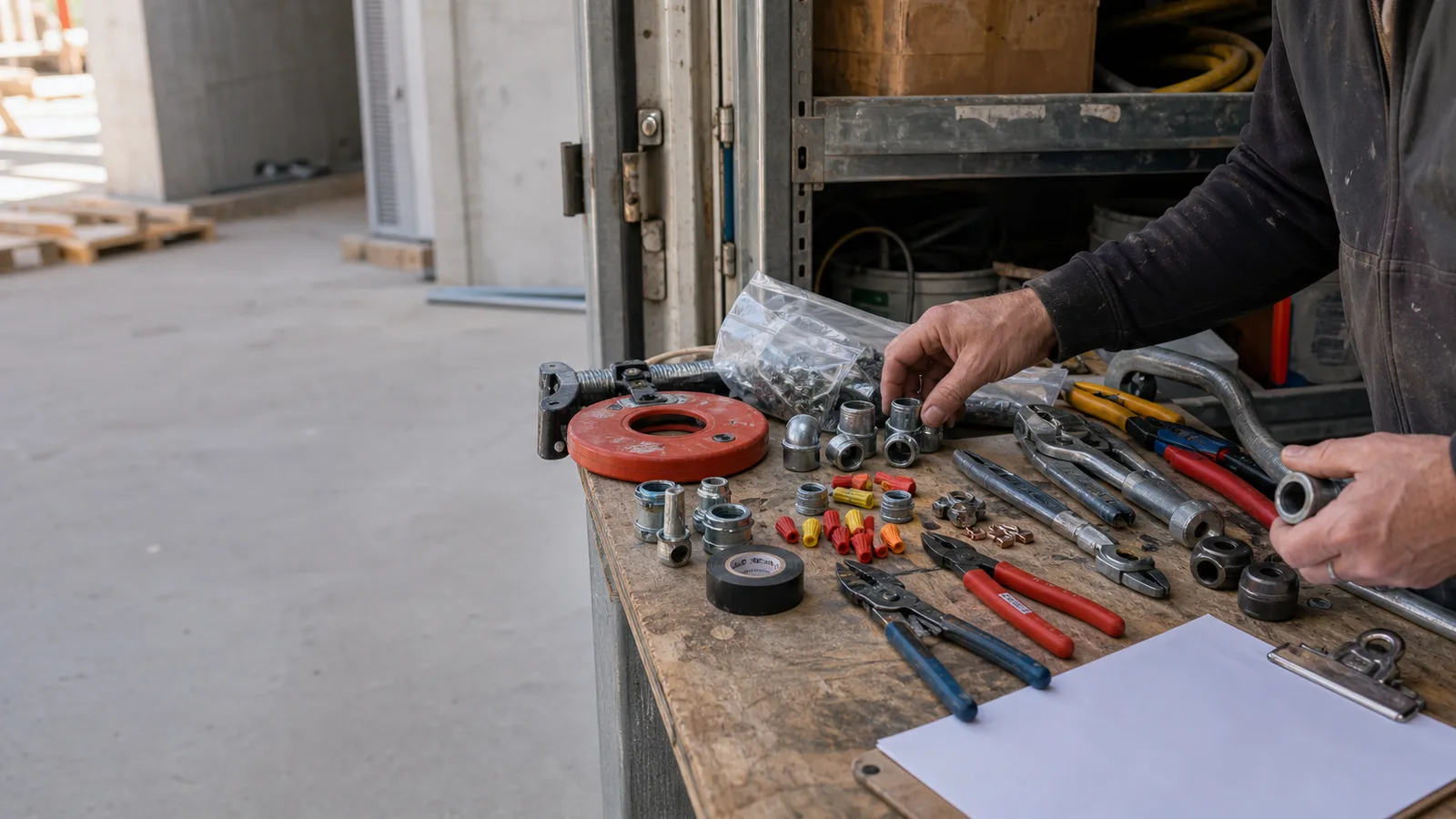
Four buckets. Almost every argument about a tool charge comes from an item sitting in the wrong one.
Sort your inventory once, write the buckets into your T&M authorization, and most of the argument stops happening before the job starts.
| Bucket | Typical items | How it is normally billed | What backs it up |
|---|---|---|---|
| 1. In the labor rate | Screwdrivers, side-cutters, strippers, pliers, tape measure, torpedo level, hand bender, hand meter, basic cordless drill/driver | Not billed separately — included in the hourly rate | Nothing. It is in the rate. |
| 2. Consumables (used up on this job) | Hole saws, twist and step bits, core bits, recip and band-saw blades, wedge anchors, tie wire, anti-ox, wire nuts, tape, layout markers, PPE issued for the scope | Documented cost plus markup, itemized by date and quantity | Receipts plus a dated field log |
| 3. Contractor-owned equipment (replacement value roughly $500+) | 555-class bender, threader, cable puller, KO set, hydraulic crimper, rotary hammer, thermal imager, 20 ft and taller ladders | Published day or week rate, itemized by date and job | Your published rate sheet plus a dated log of what went to the job |
| 4. Rented | Scissor lift, boom, generator, trencher, vac excavator, anything off the rental house counter | Rental invoice plus tax and delivery, plus your stated overhead and profit | The rental ticket, attached to the invoice |
The fight is almost always bucket 1 versus bucket 2. Customers accept that a core bit gets used up on their slab.
They resist paying for a screwdriver, and they are right to resist unless the contract says otherwise. That is why the buckets have to be named in writing beforehand rather than defended afterward.
Is a Small Tools Charge Double-Billing?
A small tools charge is double-billing only when the same cost is collected twice — when your hourly labor rate was already built to absorb small tools and you add a tools percentage on top of it.
Your labor rate carries burden, overhead, and profit. If small tools were folded into that overhead when you built the rate, a separate small tools line charges twice for the same cost — and any owner's auditor will say so.
Pick one, and put it in writing:
- Absorbed. Small tools live in the hourly rate. No separate line. Consumables and equipment still bill separately.
- Separate. Small tools are excluded from the rate build and billed as their own line at a stated percentage or flat rate.
The Three Ways Contractors Bill Small Tools on T&M
There are three billing methods plus one honest fourth option, which is not to bill the line at all.
| Method | How it works | Best when | The objection you will get |
|---|---|---|---|
| Percentage of labor | A stated percentage of a defined labor base, with a cap | Longer T&M runs with a steady crew | "A percentage of what?" — answer it in the clause |
| Flat rate per man-hour | A fixed dollar amount per field hour worked | You want a number the customer can verify by multiplying | "How did you arrive at that rate?" — keep the build |
| Itemized cost-plus | Every consumable and every piece of equipment billed line by line | Short, consumable-heavy scopes: core drilling, demo, anchor work | "Prove it was used here" — receipts and a dated log |
| Absorbed in the rate, or a daily truck charge | No tools line at all; tools live in the hourly rate or in a flat per-day service-truck charge | Small service T&M and long-standing customers | Almost none — that is the entire point |
For the percentage method, the convention you will see quoted is roughly 2–3% of unburdened labor cost for tools under about $500, with anything above that billed at a day rate instead. Some contract forms cap it outright: not to exceed 3 percent of net labor cost.
For owned equipment there is a published rate book to point at: the joint MCAA/NECA/SMACNA Tool and Equipment Rental Guide, which in 2022 superseded NECA's older Tool & Equipment Rental Schedule. Billing owned equipment at roughly 75% of the published rate — or at the actual rental-house rate for the same tool — is a common convention.
Both are conventions, not published standards, and neither figure comes from a survey. Check them against your own contract and your own cost history before you quote them to anybody.
That fourth row deserves more weight than it usually gets. Rolling tools into the hourly rate or a flat daily truck charge removes the most-attacked line on the invoice entirely, at the cost of a slightly higher headline rate.
If you are losing a long-term account over a charge for a 6-foot ladder, the truck-charge route is the cheaper answer. If you are not sure what your tools actually cost you per hour in the first place, that is a job costing question, and it has to be answered before you can build either the rate or the percentage.
The Base Matters More Than the Percentage
Three percent of what? Change the base and the same percentage produces very different money. Define the base in the contract or you will be negotiating it during the dispute.
Example arithmetic — inputs visible, run your own numbers. Say 3 electricians × 8 hours × 4 days = 96 field hours. Base wage $38.00/hr. Labor burden 35%, so burdened cost is $51.30/hr. Billed labor rate $95.00/hr. Small tools percentage: 3%.| Base the 3% is applied to | Base amount | 3% small tools charge |
|---|---|---|
| Net (unburdened) labor — 96 hrs × $38.00 | $3,648.00 | $109.44 |
| Burdened labor cost — 96 hrs × $51.30 | $4,924.80 | $147.74 |
| Billed labor — 96 hrs × $95.00 | $9,120.00 | $273.60 |
Same job, same percentage, and the top and bottom rows are two and a half times apart. That gap is the whole argument, and one sentence in the authorization settles it.
Here is the same example job billed the other two ways, same inputs:
- Flat rate: $1.25 per field hour × 96 hours = $120.00
- Itemized cost-plus: hole saws (2) $56.00 + wedge anchors, 3/8" (50) $34.00 + recip blades (6) $27.00 + anti-ox, 8 oz (1) $12.00 = $129.00, plus 15% markup = $148.35. Add the owned 555 bender at $150.00/day × 4 days = $600.00. Total $748.35.
Contract Language That Defines "Small Tool" Before the Job Starts
The usual conclusion in threads like that one is that the answer is whatever your contract says — and then nobody writes the clause. Here is a clause. Fill in the blanks, attach your equipment rates as Exhibit A, and get it signed with the T&M work authorization.
Small Tools, Consumables, and Equipment — Time and Material Work>
1. Small tools. Hand tools and cordless hand tools with a replacement value under $500.00 each are included in the hourly labor rates stated in this authorization and are not billed separately. (Alternative: …are billed as a small tools allowance of>___%of net labor dollars — field hours multiplied by base wage, excluding burden, overhead, and profit — not to exceed___%of net labor cost on this authorization.)
2. Consumables. Items consumed in the performance of the work — including drill bits, hole saws, core bits, saw blades, anchors, fish tape, tape, wire nuts, anti-ox compound, layout markers, and PPE issued for this scope — are billed at documented cost plus ___%, itemized by date and quantity.
>
3. Contractor-owned equipment. Equipment with a replacement value of $500.00 or more is billed at the day or week rate listed in Exhibit A, itemized by date, unit, and job. Rates in Exhibit A are ___% of the rates published in the current edition of the MCAA/NECA/SMACNA Tool and Equipment Rental Guide.
>
4. Rented equipment. Equipment rented for this scope is billed at actual rental invoice cost, plus tax and delivery, plus ___% overhead and profit. The rental ticket is attached to the invoice on which the charge appears.
>
5. Backup. Each charge under sections 2, 3, and 4 is supported by a dated entry naming the job, the item, the quantity, and the work it was used for. Charges are billed on the invoice covering the period in which they were incurred, not held to closeout.>
6. Ownership. Tools and equipment billed under sections 2 and 3 remain the property of the Contractor. Items purchased at the Owner's written direction and billed at cost become the property of the Owner at closeout.
Section 6 exists because that argument comes at the end of the job, when the goodwill is gone. Settle it while everyone is still friendly.
Section 5 is the section easiest to skip, and it is the one that gets the money released.
What a Defensible Small Tools Backup Page Looks Like
The difference between a charge that gets paid and a charge that gets struck is usually about five lines of typing.
The version that gets struck:Misc. small tools & consumables ................. $748.35
| Date | Job / Area | Item | Qty | Unit | Cost | Used for |
|---|---|---|---|---|---|---|
| Aug 4 | 2nd flr east | Hole saw, 2-1/8" | 2 | $28.00 | $56.00 | Boxes, circuits 12–18 |
| Aug 4 | 2nd flr east | Wedge anchor, 3/8" | 50 | $0.68 | $34.00 | Strut, corridor deck |
| Aug 5 | 2nd flr east | Recip blade, bi-metal | 6 | $4.50 | $27.00 | Cutting out old MC |
| Aug 5–8 | 2nd flr east | Bender, 555 (owned) | 4 days | $150.00/day | $600.00 | 1-1/4" and 2" runs, east riser |
| Aug 6 | 2nd flr east | Anti-ox, 8 oz | 1 | $12.00 | $12.00 | Feeder terminations, MDP |
| Consumables subtotal | $129.00 | |||||
| +15% markup | $19.35 | |||||
| Equipment (owned, day rate) | $600.00 | |||||
| Invoice total | $748.35 | |||||
The Cost column is what the item cost you, except the bender line, which is the owned-equipment day rate off your published sheet. Markup lands once, in the total.
Same charge, same total. Completely different conversation.
Now the part nobody writes down: the tools line rides on the labor line above it. A tool charge is a claim about work that was performed, so it is only as credible as the record of the work.
If your labor backup reads 8.77 hrs, the customer has to take the whole page on faith, and he will audit every line including the tools. If it reads Thu 7:02a–3:48p — pulled and terminated circuits 12–18, second-floor east wing, the 2-1/8" hole saws stop looking like padding and start looking obvious.
Clean hours from the crew and invoices the customer does not fight are the same mechanism, not two separate projects. There is an annotated sample billing packet showing how the hours and the notes sit together on one page with the labor amount, no signup required. The tool and consumable lines go beside it, on the backup page above.
How to Capture Tool Charges in the Field Without Slowing the Crew Down
The obstacle is never the format. It is that nobody wants to fill out a second piece of paper at 3:45 on a Thursday.
So do not create a second piece of paper. Five steps:
1. Put the tool lines on the same sheet as the hours. One document per crew per day. If the tools log lives somewhere else, it will not get filled in. 2. Pre-print your consumables list. Checkboxes with a quantity box, not an empty field. Bits, hole saws, blades, anchors, anti-ox, tape — whatever your crews actually burn through. 3. Photograph the receipt at the counter. Rental ticket, supply-house slip, tool purchase. Text it to the office the same day, with the job name in the message. A photo taken at the counter is dated for you. 4. Log equipment when it goes in the truck, not when someone remembers. One line on the tool board or the daily report: item, job, date out, date back. This is the record that answers "was it actually on my job." 5. Transfer it weekly, not at closeout. Move the week's lines onto the invoice while somebody still remembers what the bit was for. That "used for" column is impossible to reconstruct in October.Here is the log format to copy onto your daily report:
DATE JOB / AREA ITEM QTY UNIT $
USED FOR
Six columns, under a minute to fill out, and it belongs on the same sheet as the hours.
A free T&M Billing Backup Kit with four printable and spreadsheet forms — work authorization, daily field report, change order log, and labor backup sheet — is available with no signup. The daily field report already carries a materials block — item, quantity, unit, where installed, supplied by. Annotate those rows with a unit cost and a "used for" note and you have the same record, on the sheet the crew is already filling out.
Some contractors keep the hours and the daily note in a phone app so the note arrives attached to the punch instead of on a scrap of cardboard. FieldTimesheet does that part — a note at clock-out, printed on the customer billing packet — but to be clear, it does not track tools, receipts, or consumables. Those stay on the field report either way, whether you use software for the hours or a clipboard.
When to Bill It, and When You Cannot Bill It at All
Bill the tools charge on the invoice covering the period in which it was incurred. A lump sum appearing at closeout gives the customer nothing to check it against — by then he cannot connect the charge to work he remembers.
Assume the invoice will be audited. On guaranteed-maximum and cost-plus contracts it very likely will be, and on federal and most public work the owner has explicit audit rights.
Two constraints worth checking before you bill anything:
- Read the spec. Many public and federal specifications address tool charges directly, and some prohibit billing common hand tools entirely while allowing a cost-of-ownership day rate for larger equipment. The spec governs, not your standard rate sheet.
- Check the prime contract flow-down. If the GC's contract with the owner caps or disallows small tool charges, that cap flows down to you whether or not your subcontract repeats it.
For the wider process around this — authorization, daily documentation, and how the backup packet gets assembled — see T&M billing best practices.
The Short Version
Sort your tools into four buckets and write them into the authorization. Pick one base for the percentage and state it. Itemize consumables and owned equipment by date, job, and what they were used for.
Bill it in the period it was incurred, and keep the labor record next to it good enough that nobody has a reason to start auditing in the first place.
A small tools charge does not get disputed because it is unfair. It gets disputed because it is unreadable.
Frequently Asked Questions
What counts as a small tool on a T&M invoice?Whatever your contract says it is — there is no industry-wide definition, which is why the charge gets argued about. The workable split is hand tools you are expected to show up with (in the rate), items consumed on the job (billed at cost plus markup), owned equipment worth roughly $500 or more (a published day rate), and rentals (pass-through plus overhead and profit).
Is a small tools charge double-billing if my labor rate already includes overhead?It is, if the rate was built to absorb tools and you also add a percentage on top. Decide which one carries the cost, say so in the contract, and remove tools from the rate build if you are going to bill them as a separate line.
What percentage do electrical contractors charge for small tools on T&M?The convention quoted most often is 2–3% of unburdened labor cost for tools under about $500, sometimes capped at "not to exceed 3 percent of net labor cost." Treat that as a starting point rather than a standard, and confirm the base — 3% of billed labor is far more than 3% of net wages, as the worked example above shows.
What is the difference between small tools and consumables on an invoice?A small tool survives the job; a consumable is used up on it. A screwdriver goes back in the van, a 2-1/8" hole saw comes off it dull. That is the practical line customers accept, and it is why consumables bill cleanly with a receipt while small tools usually belong in the rate.
Can a customer refuse to pay a small tools charge?Yes, if the contract does not authorize it or does not define it. A charge the contract never mentions is a charge the owner can strike on principle, and most owners will. A defined charge with dated, itemized backup is a much harder line to reject.
Do you bill small tools on top of material markup?They are separate charges covering separate costs, and they can both appear on the same invoice — but only if the contract names both. Material markup covers material you install; the tools charge covers what was consumed or worn out installing it. Listing them as one blended line is what makes an owner suspect double-billing.
Should you bill small tools every invoice or as a lump sum at closeout?Every invoice, in the period the charge was incurred. A lump sum at closeout gives the customer nothing to check it against — by then he cannot connect the charge to work he remembers, so the only move left to him is to challenge the whole number.
Who owns tools that were billed to a T&M job?Whoever the contract says, which is why section 6 of the clause above exists. The usual position is that tools billed at a day rate or as a percentage stay with the contractor, while anything purchased at the owner's written direction and billed at cost belongs to the owner at closeout.