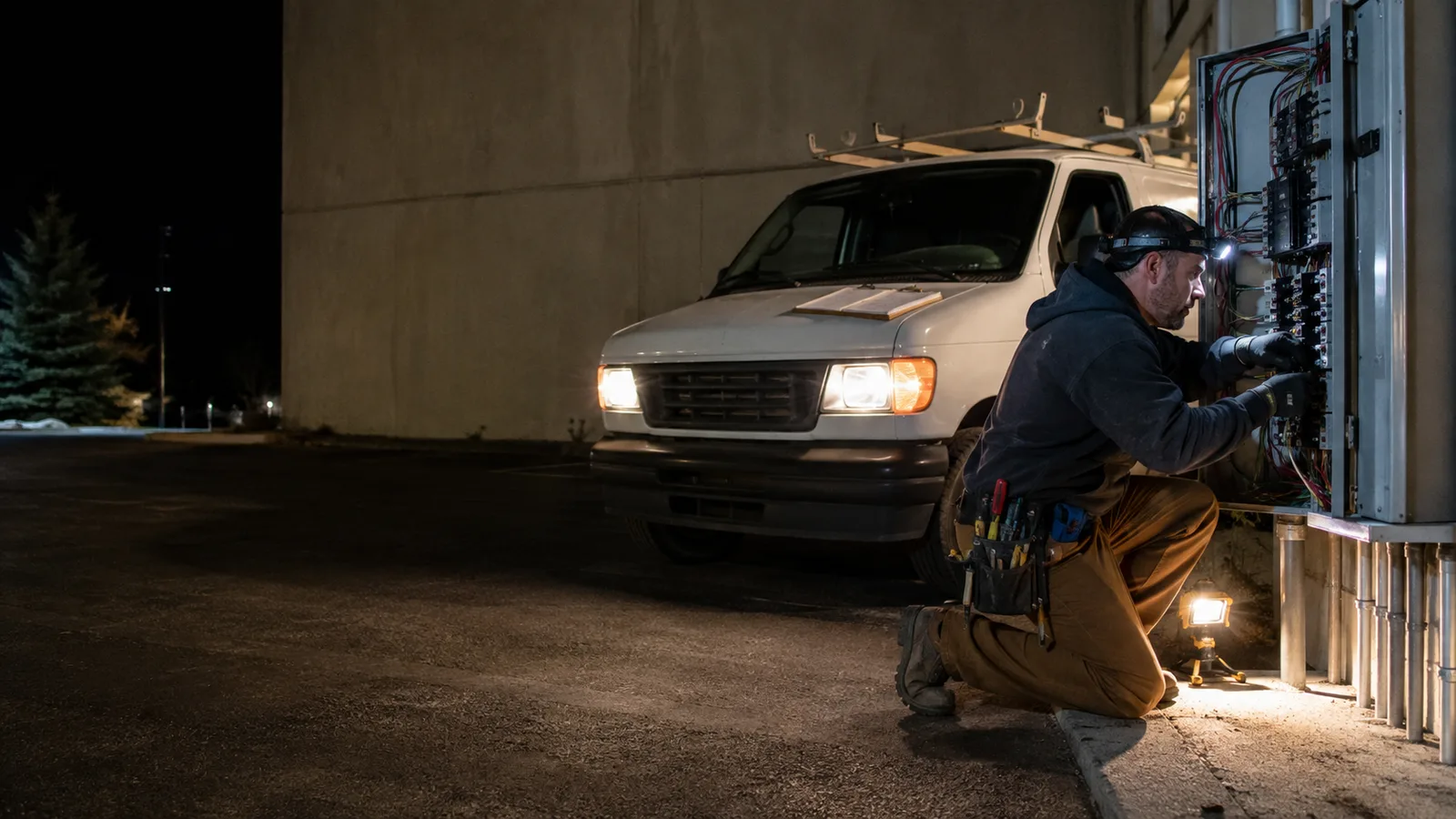
The call itself goes fine. Dead panel at 11:47 at night, truck rolls, power back on before 2 a.m., everybody says thank you.
Three weeks later the invoice lands and the emergency is a memory. That is where electrician emergency after hours call out billing actually breaks — not at dispatch, but at the moment a customer looks at a number they cannot reconstruct.
They are staring at the two things they have no way to check: a multiplier and a minimum. So they assume padding.
The charge was fair. The explanation was missing.
What follows is the whole method — what to agree on before the phone rings, the four timestamps that turn a minimum into arithmetic, the exact wording for the ticket, and the invoice line by line. Copy any of it.
Why the After-Hours Call-Out Is the Invoice Customers Fight
An after-hours call-out is the invoice with the least evidence behind it, because the two things that make it expensive are the two things the customer cannot verify: the premium rate and the call-out minimum.
On a daytime T&M ticket the customer saw the van in the lot. At 1 a.m. nobody watched the work, and by the time the bill arrives the panic that justified the price is gone.
Published cost guides show the numbers in play. HomeGuide's 2026 electrician cost guide puts emergency and 24-hour service at $150 or more per hour, notes a separate $40 to $100 call-out or trip fee that is not applied to the first hour, and says most electricians charge a one-to-two-hour minimum.
Those are ordinary, common terms. They are also exactly the terms that read as invented when they show up on an invoice for the first time.
Everything below is aimed at one outcome: the customer can reconstruct the charge without calling the office.
Set the After-Hours Rules Before the Phone Rings
Put the window, the multiplier, the trip fee, and the minimum in writing and get it acknowledged once. Then the 2 a.m. call is a lookup, not a negotiation.
Here is clause language you can drop into a service agreement or a standing rate sheet:
After-hours service. Standard hours are Monday through Friday, 7:00 a.m. to 5:00 p.m. Work performed outside those hours, on weekends, or on the holidays listed in Exhibit A is billed at 1.5x the standard labor rate; calls beginning between 10:00 p.m. and 6:00 a.m. are billed at 2x. A trip charge of $____ applies per dispatch and is not credited against labor. Each after-hours dispatch carries a minimum of 2.0 billable hours, measured portal to portal from our shop. Time is recorded in 15-minute increments. Materials are billed at cost plus ____%.
Fill in your own numbers. What matters is that every figure on the eventual invoice traces back to a line the customer already saw.
| What the rate sheet has to name | What happens when it does not |
| After-hours window: exact clock times, days, and the holiday list | "It was only 5:15" becomes a discount request |
| Multiplier: 1.5x, 2x, and when each applies | The premium reads as a number invented that night |
| Trip or dispatch charge: amount, per dispatch, credited or not | Customer assumes it is double-billed against the first hour |
| Minimum billable hours, and whether it runs portal to portal or on site | Nothing on the invoice explains why 2.0 hours was billed for 45 minutes |
| Rounding increment, 15 or 30 minutes | Every timestamp turns into a negotiation |
| Second man or apprentice rate after hours | The bill gets challenged for "sending two guys" |
| Return-trip policy when the part is not on the truck | Customer expects the second trip free |
| Material markup and any after-hours supply-house surcharge | Parts lines look like padding |
When Does the After-Hours Clock Start and Stop?
The after-hours clock starts and stops wherever your written rate sheet says it does. The failure is having no rule and then picking one while writing the invoice.
Pick one of these and publish it:
- Portal to portal. The clock starts when the tech leaves the shop or their house and stops when they get back. Defensible, simple, and the premium covers the drive.
- On site only, plus a flat trip charge. The clock runs from arrival to departure, which is easier for a customer to check against their own building logs.
Three edge cases worth deciding in advance:
- Crossing into the window. A job that runs 4:30 p.m. to 7:00 p.m. bills straight time to 5:00 and premium after. State it as "premium applies to hours worked inside the window" and show both lines.
- Crossing into a higher tier. Same rule at the 10 p.m. boundary. Split the line rather than averaging it.
- Return trip for a part. Bill it or absorb it, but decide in the rate sheet, not after the customer asks.
The Four Timestamps That Turn a Minimum Into Arithmetic
Four times, recorded as they happen, are what let a customer follow the bill: call received, left for site, on site, left site.
| Timestamp | Where it comes from | What it settles |
| Call received | Phone log, text, answering service ticket, email header | The emergency started when they said it did, and premium time was authorized then |
| Left for site | The tech's own record at the truck | The portal-to-portal clock start, and the response time you are actually selling |
| On site | Recorded at arrival | Matches the building's access-control or alarm log, so the customer can confirm it themselves |
| Left site | Recorded at departure, signed if anyone is there | Where the clock stopped, and what was still outstanding |
That sentence is the whole mechanism. Hours prove a tech was somewhere; the sentence proves what the customer got for the money.
Any method that captures those five things works — a paper ticket in the truck, a photo of a filled-out form, a text to the office, or a phone app. FieldTimesheet is one of the app options: it records a clock-in and clock-out with a free-text note at clock-out and one GPS point at each punch, and prints a billing packet from it, though the call-received time and the customer signature still come off the paper ticket and hours only reach QuickBooks when an admin pushes them by hand.
If you want a form already laid out for this, the T&M Billing Backup Kit includes a labor backup sheet and a daily field report you can print and keep in the truck.
Getting the Crew to Write the Note at 1 A.M.
Ask for one sentence, not a report, and say why it exists: the note is what stops a customer chiseling the company on work the crew actually performed.
Three blanks on the ticket do the job — FOUND, DID, VERIFIED. Nobody has to write a paragraph.
Fill them in before leaving site. By the next morning the specifics are gone and what comes back is "fixed the panel," which settles nothing.
Give the crew the format instead of asking for detail in the abstract. "Traced dead short to failed 40A 2-pole in panel B" is one line, and every electrician can write it in fifteen seconds.
Then do not ask twice. If the ticket already carries the hours, payroll should not be asking for them again on a separate electrician timesheet on Monday.
Read one good note back at the Monday huddle. Showing the crew what a note settled is more concrete than restating the policy.
How to Bill a 2-Hour Minimum on a 40-Minute Fix
Bill the minimum, label it as a minimum on its own line, and print the actual on-site time next to it.
A 2-hour minimum hidden inside "2.0 hrs labor" gives the customer nothing to check. The same charge shown as a minimum, with 45 minutes of on-site time beside it, gives the customer both numbers to check.
Example, with every input visible. Substitute your own rates.
| Input | Example value |
| Standard bill rate | $95.00/hr |
| After-hours multiplier | 1.5x, so $142.50/hr |
| Trip charge | $95.00 per dispatch, not credited against labor |
| Call-out minimum | 2.00 hr, portal to portal |
| Material | One 40A 2-pole breaker, $78.00 |
| Line | Detail | Amount |
| After-hours call-out minimum | 2.00 hr at $142.50/hr (1.5x standard $95.00). Portal-to-portal time 1.65 hr; the 2.00 hr minimum applies per acknowledged rate sheet | $285.00 |
| Trip charge | One dispatch, 11:47 p.m. call | $95.00 |
| Material | 40A 2-pole breaker, truck stock | $78.00 |
| Total | $458.00 |
The Call-Out Ticket, Word for Word
Everything above fits on one page the tech fills out before leaving site. Copy this onto a form, print a stack, and keep them in the truck.
AFTER-HOURS CALL-OUT TICKET
Job / site: ____________________   Date (night of): __________
Call received: ______ a.m./p.m.    From: _______________________
Caller phone: ______________  PO / work order #: ______________
Reported problem, caller's words: _____________________________
Rate acknowledged: $______/hr, ______ hr minimum, trip $______
Acknowledged by (name and time): ______________________________
Left for site: ______            On site: ______
FOUND: ________________________________________________________
DID: __________________________________________________________
VERIFIED / TESTED: ____________________________________________
Materials (truck stock / supply house): _______________________
Left site: ______    Return trip needed? Y / N   For: _________
Still outstanding: ____________________________________________
Tech: __________________   Customer signature: ________________
Printed name: __________________   Time signed: _______________
The note that goes on the invoice comes straight off the middle of that ticket:
Sat 12:31a-1:16a - traced dead short to failed 40A 2-pole in panel B, replaced breaker and retorqued lugs, verified circuits 4-9 restored and building lights back on at 1:12a
"Emergency service call, 2 hr min" is an assertion. The line above is a record, and a customer reading it has nothing left to ask.
The Invoice, Before and After
Same money, opposite outcome. The only difference is how much of the night the invoice carries with it.
| Invoice line as written | What the customer does with it |
| Emergency service call, after hours, 2 hr min at 1.5x — $285.00 | Calls the office to ask what the two hours were spent on. Nobody in the office was there, so the answer is a guess, and a guess sounds like a defense |
| After-hours call-out minimum, 2.00 hr at $142.50 (1.5x standard $95.00) per acknowledged rate sheet. On site 12:31a-1:16a; portal to portal 1.65 hr. Traced dead short to failed 40A 2-pole in panel B, replaced breaker, verified circuits 4-9 restored, building lights back on 1:12a — $285.00 | Can match the times against their own access log without calling the office |
Commercial, GC, and Property-Manager Call-Outs
On commercial work the record has to satisfy an accounts-payable department rather than a homeowner, which means getting a number on the ticket before the truck rolls.
- Get a PO or work order number on the phone. If the caller cannot produce one at midnight, write down who authorized the dispatch and at what time, then text them a confirmation before leaving.
- Ask for the not-to-exceed amount. If there is not one, state yours: work stops and you call at $X.
- If the call lands on an active contract job, it is a change order, not a service call. Write it as one that week and reference the ticket number.
- Get the ticket signed on site. A building engineer's signature at 1 a.m. outweighs three emails sent later.
- Match the AP portal's fields. Many require tech name, arrival, and departure in specific boxes, and the four timestamps fill all of them.
Check the Premium Against What the Call-Out Costs You
Run the payroll side once, on your own numbers, so you know whether the multiplier clears cost. A 1.5x bill rate on a 2x pay night does not.
Under the Fair Labor Standards Act, overtime is owed at 1.5x the regular rate for hours worked over 40 in a workweek. The Department of Labor is explicit that extra pay for night, weekend, or holiday work is a matter of agreement between employer and employee, not a federal requirement.
So the premium you owe the tech and the premium you bill the customer come from two different documents. State daily-overtime rules can require more — California and Alaska owe overtime past 8 hours in a day, Nevada past 8 hours for employees under a wage threshold, and Colorado past 12. IBEW inside agreements typically carry their own call-out and show-up minimums, so read the call-out language in your local's agreement before setting a billed minimum shorter than the one you have to pay.
Example, same call as above, with every input visible:
| Input | Example value |
| Base wage | $38.00/hr |
| FLSA overtime, over 40 in the week, at 1.5x | $57.00/hr |
| Burden at 35% for taxes, insurance, truck, phone | $76.95/hr loaded |
| Paid portal to portal, 1.65 hr | $126.97 |
| On-call stipend for carrying the phone that night | $25.00 |
| Example cost of the call-out | $151.97 against $285.00 of billed labor |
What it costs to have somebody carrying the phone at all is a separate line worth pricing, and that is covered in how to bill standby and on-call time.
When the Customer Pushes Back on the Charge
Send the record, not an argument. A customer who can follow the night in order has nothing left to ask about.
Wording you can send as-is:
Attached is the call-out ticket for the night of the 14th. Call received 11:47 p.m. from the building manager, on site 12:31 a.m., left site 1:16 a.m. The failed component was a 40A 2-pole breaker in panel B, and circuits 4 through 9 were verified back on at 1:12 a.m. The 2.00-hour after-hours minimum and the 1.5x rate are from the rate sheet acknowledged by email on the 3rd, copy attached. Glad to walk through any line on it.
If the objection is specifically the minimum, there are two honest options, and choosing one in advance beats improvising: hold it because it was acknowledged in writing, or credit it once and put the rate sheet in front of them for next time.
What is not on the list is discounting work that was performed because the paperwork could not explain it.
To price out what the argument itself costs before deciding, the invoice dispute calculator runs it on your own inputs, and what to send when an invoice gets challenged covers the backup packet in more detail.
Frequently Asked Questions
Can I charge a 2-hour minimum if the fix only took 20 minutes?
Yes, when the minimum was in writing and acknowledged before the call. Show it on the invoice as a minimum with the actual on-site time next to it — a minimum that appears for the first time disguised as "2.0 hrs labor" gives the customer nothing to check.
Do I have to give the customer an itemized after-hours bill?
Federal law does not require it, and on commercial T&M your contract governs. Your state contractor board may require written terms and itemization on residential work, so check before sending a one-line invoice.
When does after-hours start?
After-hours starts whenever your rate sheet says it starts, as long as the rate sheet said so before the call. A common structure is standard hours 7 a.m. to 5 p.m. Monday through Friday, 1.5x outside that and on Saturdays, and 2x overnight, Sundays, and named holidays.
Should I bill travel time on an emergency call-out?
Pick portal-to-portal or a flat trip charge and say which one in the rate sheet. Billing drive time and a trip fee for the same dispatch invites a dispute unless the clause spells out what each one covers.
How do I prove what time the crew actually arrived?
Record the timestamp at the moment rather than the next morning, and corroborate it with something the customer already holds: their access-control or alarm log, the building automation alarm, the utility outage record, or the timestamp on the text sent from the truck. A GPS point captured at clock-in supports the arrival time as corroboration, not as proof on its own.
Does after-hours work require overtime pay?
The FLSA requires overtime at 1.5x the regular rate for hours over 40 in a workweek, and the Department of Labor treats extra pay for night, weekend, or holiday work as a matter of agreement. State daily-overtime rules and union call-out or show-up minimums can require more, so check both before setting a bill multiplier.
What if the customer authorized the call at 2 a.m. and now denies it?
Text a confirmation before the truck rolls — who called, what they reported, and the after-hours rate and minimum that apply. A one-line text with a timestamp is the cheapest authorization record there is, and it outlives the memory of a panicked phone call.
Can I use a regular electrician timesheet template for a call-out?
Not on its own. A standard contractor timesheet captures hours; a call-out also needs the call-received time, who authorized it, what failed, and what was verified, so either add those four fields or keep a separate call-out ticket in the truck.
An after-hours call-out bills at a premium for work nobody but the tech watched. Four timestamps and one sentence, written the night it happened, are what let the customer reconstruct it.