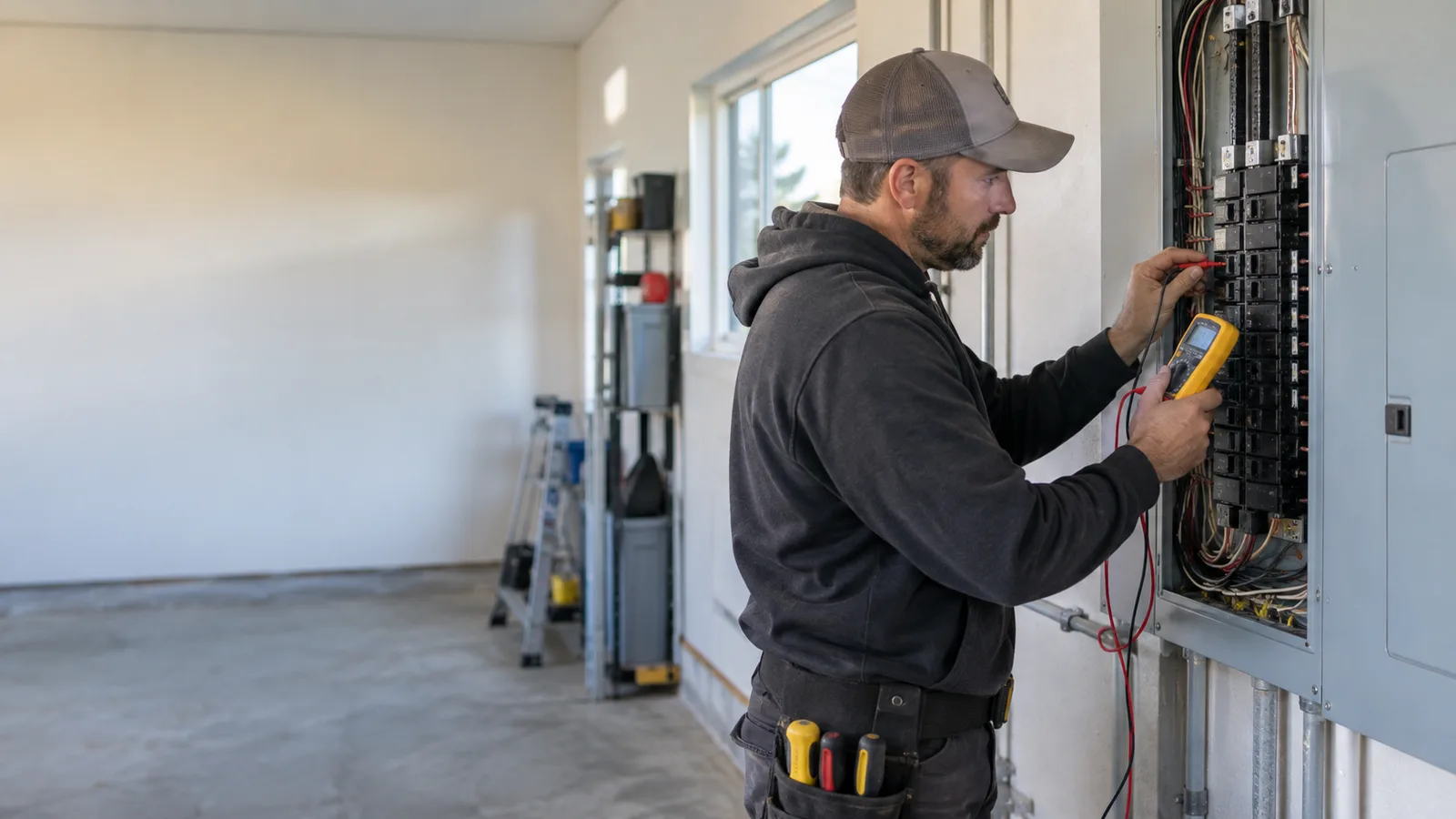
The tech was on site 52 minutes. Nothing got replaced. The invoice says $150 — diagnostic fee.
The customer calls the next morning and asks what, exactly, they paid for.
Every argument about electrician diagnostic fee vs repair estimate billing starts right there. Almost none of them are actually about the price.
The fee was fair. The paperwork didn't explain it.
The short version:- A diagnostic fee and a repair estimate are two separate billable events with two separate deliverables.
- The diagnostic's deliverable is not "we came out." It is a written findings record: what was tested, what was ruled out, what was found.
- Decide your credit policy before the truck rolls, put it in writing, and show the credit as a visible line on the estimate.
- Flat rate or T&M both work. The dispute comes from the documentation, not the rate.
Diagnostic Fee vs. Repair Estimate: What's Actually Different
A diagnostic fee buys a finding. A repair estimate buys a fix. Two events, two deliverables, two decisions the customer makes at two different moments.
The customer only accepts the second number if they can read the first one.
| Diagnostic visit | Repair |
|---|
| What the customer is buying | A located, named fault | A fix at an agreed price |
| Your deliverable | A written findings record | Completed work plus labor backup |
| Priced as | Flat fee covering the first hour, or hourly with a minimum | Flat-rate task price, or T&M against an approved estimate |
| Quoted | Before the truck rolls | After the diagnostic, in writing |
| What ends the dispute | The ruled-out list | An estimate that cites the findings by line |
Most homeowner-facing explainers stop at "the fee pays for the expertise it takes to find the fault." That is true, and it settles nothing.
Expertise is invisible on an invoice. A list of twelve receptacles you tested is not.
What a Diagnostic Fee Actually Covers
It covers the knowing and the proving: the trip, the meter time, the circuits you eliminated, and the write-up that tells the customer and the next electrician what is wrong.
Four things go into the number, whether you charge flat or hourly:
- The roll — truck, fuel, drive time, the slot on the schedule.
- The elimination — every circuit, device, and connection you cleared is work the customer doesn't have to pay for twice.
- The find — the fault, located and named, with a circuit number attached to it.
- The record — the sheet that makes 1 through 3 checkable by somebody who wasn't there.
What Electricians Charge for a Diagnostic
There is no authoritative national number — no survey, no licensing-board table, no published standard. There are two things you can go read for yourself, and they point at the same structure.
Published pricing guides put the service call or diagnostic fee at roughly $75 to $200, covering travel plus the first hour on site, with hourly billing after that — see HomeGuide's electrician cost-per-hour page and Housecall Pro's electrical pricing guide. Those are directional estimates compiled by lead-generation sites, not survey data. Contractors posting their own numbers land on the same shape. The rate threads on ElectricianTalk run from the early 2010s to 2026, and the structure that keeps recurring is a flat fee covering the first hour, then hourly after — sometimes with a separate trip charge, sometimes with the diagnostic waived if the repair is approved. The figures themselves vary enormously by region and by era, so read them yourself rather than taking a number secondhand: Pricing for troubleshooting, Service Call Rate vs Hourly Rate, Service call rate, Service call hourly rate, and Troubleshooting rates.None of that sets your price. Your costs and your market set your price. What the structure gives you is a number you can say out loud on the phone before you drive out.
Example arithmetic — this is the scenario carried through the rest of this article. Inputs: $145 flat covering the first hour, $110/hr after that, 2.6 hours on site. $145 + (1.6 × $110) = $321. Swap in your own first-hour fee and hourly rate and the structure still holds.Whether you price the diagnostic flat or as flat rate versus time and materials changes your risk profile. It does not change whether the charge gets argued. That is decided by the paperwork.
Should You Credit the Diagnostic Fee Toward the Repair?
Credit the diagnostic fee toward the repair if you want the repair work — but never call the diagnostic free, and never let the credit disappear quietly into a lower price. Pick one policy, say it out loud before the truck rolls, and print the credit as its own line on the estimate.
A credit the customer can see reads as a discount. A price that is silently $145 lower reads as a number you made up.
| Policy | How it reads to the customer | Best when | Wording to use |
|---|
| Full credit if they proceed | "The diagnosis was on the house once I hired you" | Residential service where the repair usually follows the find — dead circuit, tripping GFCI, dead receptacles on one leg | "Diagnostic fee of $___ applies. If you approve the repair today, the full diagnostic labor is credited against it." |
| Credit the labor hour only, keep the trip charge | Fair split — you still drove out | Long drive times, rural service areas | "The $___ diagnostic hour is credited to an approved repair. The $___ trip charge is not." |
| No credit, ever | Clean, if you said it first | Commercial, GC, and property-manager work where the troubleshooting is the deliverable — feeder and panel faults, nuisance tripping across several circuits, a panel schedule nobody has | "Diagnostics are billed separately from repair work and are not credited. You own the findings either way — the circuits cleared, the fault located, and the corrected panel schedule." |
The decline case is the one to get right. If they take the findings and hire someone else, you keep the fee and they keep the sheet — say that up front, in that order, and hand the sheet over anyway.
The customer who shops your findings is handing your document to the next electrician. Your write-up becomes the scope that person has to bid against.
What to Say Before You Drive Out: The Diagnostic Authorization
Say the fee, say what it covers, say where you stop and call. Three sentences on the phone, the same three in writing on the work order.
Here is the phone version:
"Troubleshooting is $145, which covers the first hour on site. If I find it inside that hour, that's the whole diagnostic charge. If it's going to take longer, I stop at one hour and call you with what I've ruled out before I run the clock any further. If you approve the repair today, that $145 comes off the repair."
Then get it on paper before work starts. A diagnostic authorization needs five fields and nothing else:
- The flat fee and what it covers (say "the first hour on site," not "the service call")
- The hourly rate after that
- The stop point — the hour, or the dollar figure, where you come back for approval
- A not-to-exceed cap the customer agrees to now
- Whether the fee is credited to an approved repair
The Diagnostic Findings Record: Five Lines That End the Argument
The findings record is the product of a diagnostic visit. It answers the only question the customer has: what did the money buy?
Five lines, filled out before the tech leaves the driveway:
- When — arrival and departure times, to the minute
- Where — panel, circuit number, room, device
- What was tested — the circuits, devices, and connections you checked
- What was ruled out — the breaker, the GFCI, the fixture, the neighbor's tenant
- What was found — the fault, in plain language, with its location
| What most work orders say | What ends the conversation |
|---|
| 1.7 hrs — troubleshoot | Tue 8:10a–9:52a — isolated dead circuit 14 at kitchen GFCI. Tested and cleared 12 receptacles downstream, the breaker, and the GFCI device. Traced open neutral to a buried junction box above the hall ceiling. Box is not accessible; repair requires opening drywall. |
| Diagnostic fee — $222 | Diagnostic, 1.7 hrs ($145 first hour, $110/hr after). Ruled out: breaker, device, downstream receptacles. Found: open neutral, J-box above the hall ceiling. Findings sheet attached. |
Same hours. Same charge. One of them gets paid on Friday.
That is the whole mechanism: the note your tech writes in the field is the explanation your customer reads at the kitchen table. It is not a second task on top of time tracking — it is the reason the hours are worth anything after the job closes. There is more on the wording itself in what to write on an electrician's timesheet.
How the Findings Flow Into the Repair Estimate
The repair estimate should read as a consequence of the findings sheet, not as a new number. Cite the finding by line, then price the fix.
Write the estimate so a reader can trace the price back to something that was tested:
Estimate #1042 — repair per diagnostic findings 9/09. Open neutral located in a buried junction box above the hall ceiling (findings line 5). Scope: open and patch one 12" x 12" section of drywall, remake neutral splice in an accessible box, install access cover, test circuit 14 and all downstream receptacles. 2.0 hrs @ $110/hr, materials $38.
And the invoice that follows shows both events on one page, with the credit visible:
| # | Description | Qty | Rate | Amount |
|---|
| 1 | Diagnostic — Tue 8:10a–9:52a. Findings sheet attached. | 1.7 hr | $145 first hr, $110/hr after | $222 |
| 2 | Repair per approved estimate #1042 — remake neutral splice, J-box above hall ceiling | 2.0 hr | $110/hr | $220 |
| 3 | Materials — box, cover, splice, patch | — | — | $38 |
| 4 | Credit — first diagnostic hour applied to approved repair | — | — | −$145 |
| Total | $335 | |||
Four lines. Nobody has to call and ask whether they were billed twice, because line 4 says they weren't. If you want to see what a full labor backup packet looks like behind an invoice like this, there is an annotated sample billing packet on this site with no signup on it.
The Four Cases Where Diagnostic Billing Goes Sideways
The diagnosis runs past the first hour
Stop at the stop point and call. Report what you ruled out before you ask for more time — that is what makes the ask sound like progress instead of a meter running.
Example arithmetic. Inputs: $145 first hour, $110/hr after, not-to-exceed 3.0 hours. Cap = $145 + (2 × $110) = $365. At the one-hour mark: "I've cleared the breaker, the GFCI, and twelve receptacles. I need up to two more hours to trace it — that's up to $220 more, $365 all in. Do you want me to keep going?"Get the "yes" as a text and paste it onto the work order. A text reply that says "approved" is a record made before the work — check your state's rules on what has to be in writing before you rely on it as your only authorization.
The fault is intermittent and you need a second trip
Bill the second visit as its own diagnostic. It is a second roll and a second hour, and it gets its own findings sheet.
What makes it billable without a fight is the conditions log from visit one: when the fault appears, what load is on, what weather or time of day. Written down on trip one, the second trip reads as a plan. Undocumented, it reads as a do-over.
The customer declines the repair
You keep the fee. They keep the findings sheet. Say both halves before the visit and the decline is a transaction, not a dispute.
Then send the estimate anyway, with the findings attached. A declined estimate with the findings attached is the number the next bidder has to beat.
You find two or three problems
Charge one diagnostic, then sort the findings into tiers. One approach is three tiers and only three: fix now, recommended, whenever you're ready.
Do not split one diagnostic fee into three fees. You found them on one visit, on one hour of elimination — bill it once and let the repair options carry the additional price.
If the scope grows while you're standing there, that is a change order, not a bigger invoice. Same rule as any T&M billing best practice: written before the work, not explained after it.
What Your Customer Is Thinking
Contractors hear four objections. Each one is really a question, and each question has one line of paperwork that answers it.
| What they say | What they're asking | The line that answers it |
|---|
| "You were only here 40 minutes." | Am I paying for time, or for knowing where to look? | The ruled-out list — 12 receptacles downstream, breaker 14, the kitchen GFCI device, all cleared |
| "Nothing got fixed." | What did the money actually buy? | The found line — open neutral on circuit 14, buried J-box above the hall ceiling |
| "Is this on top of the repair?" | Am I being billed twice for the same visit? | The credit line, printed on the estimate |
| "How do I know that's really the problem?" | Can anyone check your work? | Circuit numbers, panel location, arrival and departure times |
None of those answers is a better argument. They are all the same document, handed over before anyone had to argue.
Getting the Tech to Write the Findings Down
This is the part that actually decides whether any of the above happens, and it is not a discipline problem. A narrative written at the shop at 6pm is a reconstruction — the circuit numbers are already gone.
What works is three prompts, printed on the work order, answered before the truck leaves the driveway:
- Tested:
- Ruled out:
- Found:
- Voice-to-text is fine. Spelling does not matter. Circuit numbers do.
- Fragments, not sentences. "Cleared bkr 14, GFCI kitchen, 12 recepts downstream" is a complete answer.
- Written on site, not at the shop. The detail is gone by the truck ride home.
- Never ask for a paragraph. Ask for three lines.
A clipboard and a phone camera do this job for free. If you already run digital timesheets, the note can ride with the hours instead of living on a second piece of paper — FieldTimesheet, the product behind this site, prompts for that note when a tech clocks out and prints it on a customer-facing packet next to the hours and bill rate. It has no diagnostic-fee feature and it does not write estimates, price books, or invoices; the findings sheet and the estimate are still yours to write either way.
If you want to know what the arguing itself is worth before you change anything, you can price out what a disputed invoice costs you with your own numbers.
Frequently Asked Questions
What is a typical electrician diagnostic fee?
Published pricing guides put it at roughly $75 to $200 covering travel and the first hour on site, with hourly billing after that. Those are directional figures compiled by lead-generation sites, not survey data, and contractors posting their own numbers on trade forums land well outside that range in both directions depending on region and year. Use the structure — a flat fee for the first hour, then hourly — to sanity-check your own, and set the number itself from your costs and your market.
Should the diagnostic fee be credited toward the repair?
Only if you decide before the visit and put it in writing. Crediting it in full is common in competitive residential markets; commercial and GC work more often keeps the two charges separate, and either is defensible as long as the customer heard it before the truck rolled.
Can I charge a full diagnostic fee if I find the problem in ten minutes?
Yes. The fee pays for knowing where to look, and the ten minutes is evidence of that, not an argument against it.
Write down what you eliminated to get there. "Cleared the breaker and the device, found the open neutral at the buried box above the hall ceiling" reads as skill; a blank work order and a $150 line reads as a fee for showing up.
What if the customer refuses to pay the diagnostic fee?
Send the authorization they agreed to and the findings sheet, in that order, and ask them which specific line they dispute. Asking for the specific line narrows the argument to something checkable instead of a feeling about the total.
Disclosure rules differ by state, and some states regulate what has to be told to a residential customer before work begins. Check your own state licensing board's rules on written estimates and pre-work disclosure.
Is a diagnostic fee the same as a trip charge or a service call minimum?
No. A trip charge pays for the roll; a diagnostic fee pays for the troubleshooting once you are there. Some shops fold them into one number, which is fine as long as the invoice says which parts are included — the breakdown is covered in trip charges and service call minimums.
How do I bill a diagnostic that turns into a repair on the same visit?
One visit, two lines, and a timestamp at the handoff. Note the minute the diagnosis ended and the repair started, get approval for the repair before you start it, and show both lines plus any credit on the same invoice.
What should a diagnostic findings sheet include?
Arrival and departure times, the circuits and devices tested, what was ruled out, what was found and where, and what it will take to fix. Five lines, filled in on site.
Do flat-rate shops need this paperwork too?
Yes, and arguably more. A flat-rate diagnostic hides the hours entirely, so the findings sheet is the only thing the customer can read to see what the flat number bought.
The Rule Underneath All of It
The diagnostic fee is not a pricing problem to solve. It is a receipt problem.
Charge what the work is worth, tell the customer the number before you drive out, and hand them a record of what got tested and what got found. Do those three and the fee stops being a thing people call about in the morning.
The charge was always fair. The explanation is what was missing.