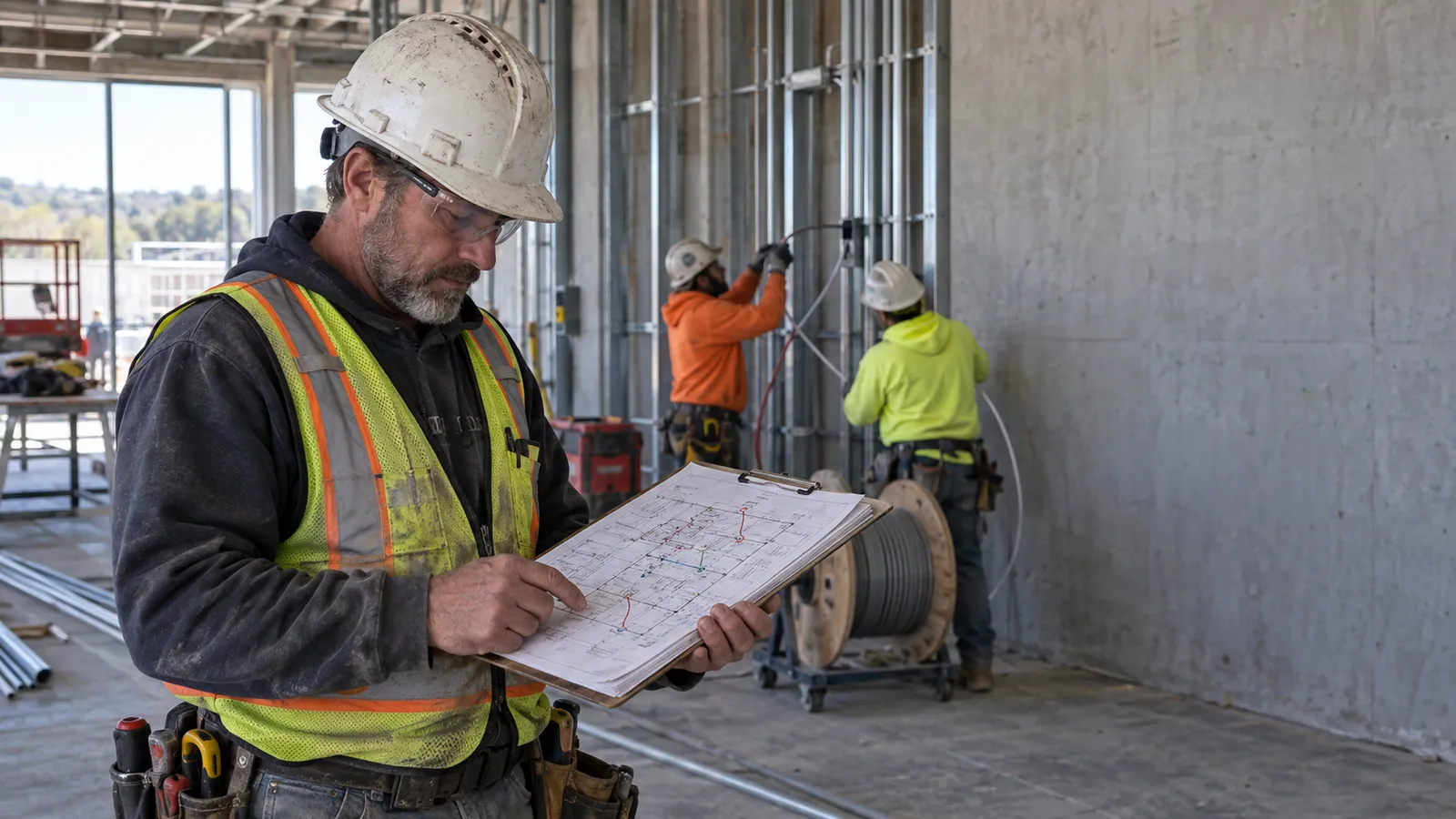
The T&M tag comes back from the GC's project manager with one line crossed out: Foreman, 8.0 hrs. Next to it, in red: "Non-working foreman. Covered in markup."
Most disputes over electrical foreman supervision time on T&M billing go this way. The crew lines get signed and the foreman line gets struck. Your foreman spent that day laying out the change, walking it with the GC's super, and staging material so three electricians could work without standing around. The PM who crossed it out wasn't there for any of that, and the tag didn't tell them.
The charge was fair. The explanation was missing. This post covers both halves: getting supervision billing agreed before the change starts, and writing the foreman's line so it holds up after.Can an Electrical Contractor Bill Foreman Time on T&M Change Order Work?
Yes, an electrical contractor can usually bill foreman time on T&M change order work, as long as the contract allows it and both sides agreed before the work started on how supervision would be billed. Working-foreman hours are labor and get billed like any other labor. Non-working supervision is the line that gets fought, and whether it's billable depends on your subcontract language, not on how hard the foreman worked.A lot of subcontracts carry language close to this: supervision and overhead directly attributable to the change may be included only if agreed in advance and not prohibited by the prime contract. That one sentence decides most of these disputes. If nothing was agreed in advance, the GC has a clause to point at.
So look in three places before you price any change:
- The prime contract's change provisions. Some owners' contracts limit what counts as a direct cost of a change. Your subcontract usually flows those limits down to you.
- Your subcontract's T&M or changes clause. Check whether it says supervision is included in the markup, allowed as a separate line, or doesn't say.
- Your rate sheet. If it lists a foreman rate, that's a sign supervision was expected to be billed as its own line. If the only rates are journeyman and apprentice, expect an argument.
Working Foreman vs. Non-Working Foreman: Why the Difference Matters
A working foreman has tools in hand and bills as labor. A non-working foreman supervises full-time, and many GCs treat that time as overhead unless the contract says otherwise. Most foremen on a 10–30 person electrical shop's jobs do some of both in the same day.That split is where the fight starts. The GC reads "foreman" as "non-working" and strikes the whole line. So write the split down instead of leaving the GC to guess.
| Foreman role | What the day looks like | How it usually bills on T&M | Where it gets disputed |
|---|
| Working foreman | Pulling wire, terminating, setting gear alongside the crew, plus running the crew | Labor hours at the foreman bill rate (or journeyman rate, if that's what was agreed) | Rarely, as long as the ticket shows installation work |
| Non-working foreman | Layout, coordination, material, inspections, paperwork; no tools | A separate supervision line if the contract allows it, or folded into markup | Constantly: "overhead already covered in markup" |
| Split day | Part tools, part supervision | Two lines, each with its own hours and description | Only when the split isn't written down |
| General foreman (larger jobs) | Runs several foremen or areas; rarely on one change's work alone | Usually overhead unless time is tied to the specific change | Almost always, unless the change was large enough to need the GF directly |
Three Ways Contracts Handle Supervision (and Which One Is Clean)
Pick one structure, write it into the T&M authorization before work starts, and don't bill supervision two ways at once. Billing a foreman's supervision hours and also charging a markup that's supposed to cover supervision is double-dipping. GCs are right to strike it.| Structure | How it works | Strength | Weakness |
|---|
| 1. Separate foreman line | Foreman hours billed at a stated foreman bill rate, markup applied the same as other labor | Clearest. Hours match what actually happened on the change | Every foreman hour gets read closely, so the description has to carry it |
| 2. Supervision percentage | A stated percentage added to crew labor to cover supervision; no separate foreman hours for non-working time | Nothing to argue about hour by hour | Over- or under-covers depending on the change. Coordination-heavy changes lose out |
| 3. Included in markup | Overhead and profit markup is understood to cover supervision; only working-foreman tool time is billed | Simple, and it's what most GCs assume by default | Non-working supervision on a big change goes unpaid unless you negotiate otherwise |
Structure 1 is the one that matches reality on most electrical changes. It is also the one that depends most on the foreman's note.
What to Put in the T&M Work Authorization Before Work Starts
Put one sentence about supervision on the authorization the GC signs before the change starts. Supervision disputes get settled at signing or not at all, because after the work is done it's your word against the markup clause.Copy and adjust this wording to fit your subcontract. Run it past whoever reviews your contracts first.
Supervision. Foreman time spent directly on this change (layout, coordination with the GC and other trades, material takeoff and staging, and inspection of the changed work) will be billed as a separate line at the foreman bill rate on the attached rate sheet, and will be recorded daily with a description of the work performed. Supervision not attributable to this change is covered by the markup and will not be billed separately.
What the clause does:
- It names the foreman activities that count, so "coordination" isn't a surprise on the tag.
- It commits you to a daily description. That's the part that makes the GC comfortable signing.
- It says out loud that general supervision is in the markup. That heads off the double-dipping objection before anyone raises it.
Why "Supervision 8 hrs" Gets Struck and What Survives Review
Foreman hours survive review when the entry says what the foreman did on the changed work: layout, coordination with the GC super, material takeoff for the change. A bare hours total reads like overhead because it gives the reviewer nothing to check.The PM reviewing your tag has three facts: a role, a number, and a markup clause. A bare "Supervision 8.0 hrs" gives them no reason to believe the hours were tied to the change. A dated description of the work gives them something they can check against their own daily log.
Here's a worked example. It's made up for illustration, not taken from a real customer.
| Line that gets struck | Line that holds up |
|---|
| Date | Thu | Thu 7:00a–3:30p |
| Who | Foreman | Foreman (R. / lead on CO-14) |
| Description | Supervision | Laid out relocated panel LP-2E and feeder route, 2nd floor east. Walked the new chase with GC super to confirm drywall hold at grid C-4. Took off and staged material for circuits 12–18. Walked rough-in with inspector before cover. |
| Split | 8.0 hrs | 5.5 hrs supervision (layout, coordination, staging, inspection) + 2.5 hrs tools (pulled home runs for circuits 12–14) |
| Rate shown | Foreman rate | Foreman bill rate, per rate sheet line 3 |
The second line answers the PM's questions before they get asked:
- Was it this change? Yes. It names the panel, the floor, the circuits, and the CO number.
- Was it overhead? No. Each activity only happened because of the change.
- Did the foreman also swing a hammer? Yes, and that time is split out and described separately.
- Can I check it? Yes. The GC super was in the chase walk and the inspector was on site.
How to Split a Foreman's Day Between Tools and Supervision
Write two lines, not one: one for tool time, one for supervision. Give each its own hours and its own description. Rough blocks written down the same day are enough. Nobody needs a stopwatch.A method that works on paper:
- At the end of the day, list what the foreman did on the change, in the order it happened. Four to six items is typical.
- Mark each item T (tools) or S (supervision). Pulling wire is T. Layout, coordination, takeoff, staging, and inspection walks are S.
- Put rough hours on each block. Half-hour increments are fine. Make sure they add up to the foreman's clock hours for the day.
- Write the S line in plain trade language. Name the location, the circuits or equipment, and who else was there. "Coordinated with GC super on chase access, grid C-4" works. "Coordination" alone doesn't.
- Get the tag signed daily while the GC's people still remember the walk.
Foreman Activities: What Usually Belongs on the Change and What Doesn't
If the activity wouldn't have happened without the change, it belongs on the tag. If it would have happened anyway, it's overhead. That test settles most borderline items.| Activity | Usually billable to the change? | How to write it |
|---|
| Layout of the changed work | Yes | "Laid out new receptacle locations, rooms 214–218, per ASI-6" |
| Coordination with GC super or other trades about the change | Yes | "Met GC super + mech foreman re: duct conflict at relocated J-box, grid D-2" |
| Material takeoff and staging for the change | Yes | "Took off and staged 3/4" EMT + wire for circuits 12–18" |
| Supply house run for change material | Often, if the contract allows travel for material | "Picked up 2 x 20A breakers for LP-2E at supply house, 45 min" |
| Inspection walk of the changed work | Yes | "Walked CO-14 rough-in with inspector, passed" |
| Directing crew on the changed work | Yes, under a supervision line | "Directed 3-person crew on feeder pull, LP-2E" |
| Weekly GC coordination meeting | No | Leave off the ticket |
| Timesheets, payroll, general safety paperwork | No | Leave off the ticket |
| Supervising base-contract work the same day | No | Leave off the ticket |
Bill Rate on the Ticket, Never Cost Rate
The customer-facing tag shows the foreman's bill rate from the rate sheet, never what you pay the foreman, and never labor cost or margin. Showing cost invites the GC to argue your markup line by line.Here's example arithmetic for the struck-line example above, using made-up inputs: a foreman bill rate of $115/hr on the rate sheet, 5.5 supervision hours plus 2.5 tool hours on the change. That's 8.0 hrs × $115 = $920 for the foreman's day on CO-14. Run it with your own rate sheet.
That $920 is what the tag shows. The foreman's wage, burden, and your margin stay on your internal job-cost report and don't go to the GC.
The same goes for the apprentice and journeyman lines on that tag. Each classification carries its own bill rate from the sheet. For the full layout of rate-sheet lines, see T&M billing best practices.
Getting the Foreman to Write the Line at All
The foreman writes a better note when he knows it's what gets his own hours paid. Frame it that way from the start: the note is how the company stops a GC from striking work he did. It isn't a check on how he spent his day.Things that make the note happen:
- Ask one question at the end of the day: "What did you do on the change today?" A short answer the same day beats a detailed one reconstructed on Friday.
- Give him the pattern: location, what was done, who else was involved. Three pieces, one or two lines.
- Show him a struck tag. A foreman who has seen his own line crossed out as "overhead" doesn't need to be told twice why the note matters.
- Let him reuse his wording. Consecutive days on the same change usually have similar notes. Starting from yesterday's note and editing it is faster than writing from scratch.
Frequently Asked Questions
Can a GC refuse to pay foreman time on T&M work?
Yes, if the subcontract says supervision is included in the markup or doesn't allow it as a separate line. If the T&M authorization you both signed names supervision as billable at a stated rate, the GC's refusal has much less to stand on. Check the prime and subcontract change clauses before the work starts, not after.
Is supervision overhead or a direct cost?
It depends on what the supervision was for. Foreman time spent only because of the change (laying it out, coordinating it, staging its material, inspecting it) is widely treated as a direct cost when the contract allows it. General supervision of the job is overhead. The ticket description is what shows which one you're billing.
Should I bill foreman hours and markup on the same change?
You can apply your normal markup to foreman labor the same way you would to journeyman labor. What you can't do is bill non-working supervision hours and also claim that the markup covers supervision. Pick one structure in the authorization and stick to it.
How should overtime supervision be billed on T&M?
Bill it at the overtime foreman rate from your rate sheet, and only if the GC directed or approved the overtime. Note who directed it on the ticket, for example "OT per GC super, 4:30–7:00p, to meet ceiling close." Overtime with no direction on record is the easiest line for a GC to cut.
What if the GC won't sign T&M tags daily?
Keep writing the daily entry anyway, and send it to the GC super the same day by email or text so there's a dated record they received. A description sent the same day is much harder to dispute a month later than one written at billing time. The invoice dispute calculator helps you weigh a slow-signing GC against the cost of pushing the issue.
Does the apprentice-to-journeyman ratio affect billable supervision?
It can support it. When the crew on the change includes apprentices who legally need supervision, note the crew makeup on the ticket, for example "directed 2 JW + 2 apprentices on feeder pull." That shows supervision the work required, not supervision added on top of it.
How detailed does the foreman's note need to be?
Detailed enough that someone who wasn't there can picture the day: where, what, and who else was involved. One or two lines is usually plenty. "Laid out LP-2E relocation, walked chase with GC super at C-4, staged circuits 12–18 material" is enough. A paragraph isn't needed.
The Short Version
- Read the prime and subcontract change clauses. Most supervision disputes are decided there.
- Pick one structure (separate foreman line, percentage, or included in markup) and put it in the T&M authorization before work starts.
- Split the foreman's day into a tools line and a supervision line.
- Describe each supervision block: location, what was done, who else was there.
- Show the bill rate on the tag. Keep cost and margin internal.
- Send the tag the same day, signed or not.