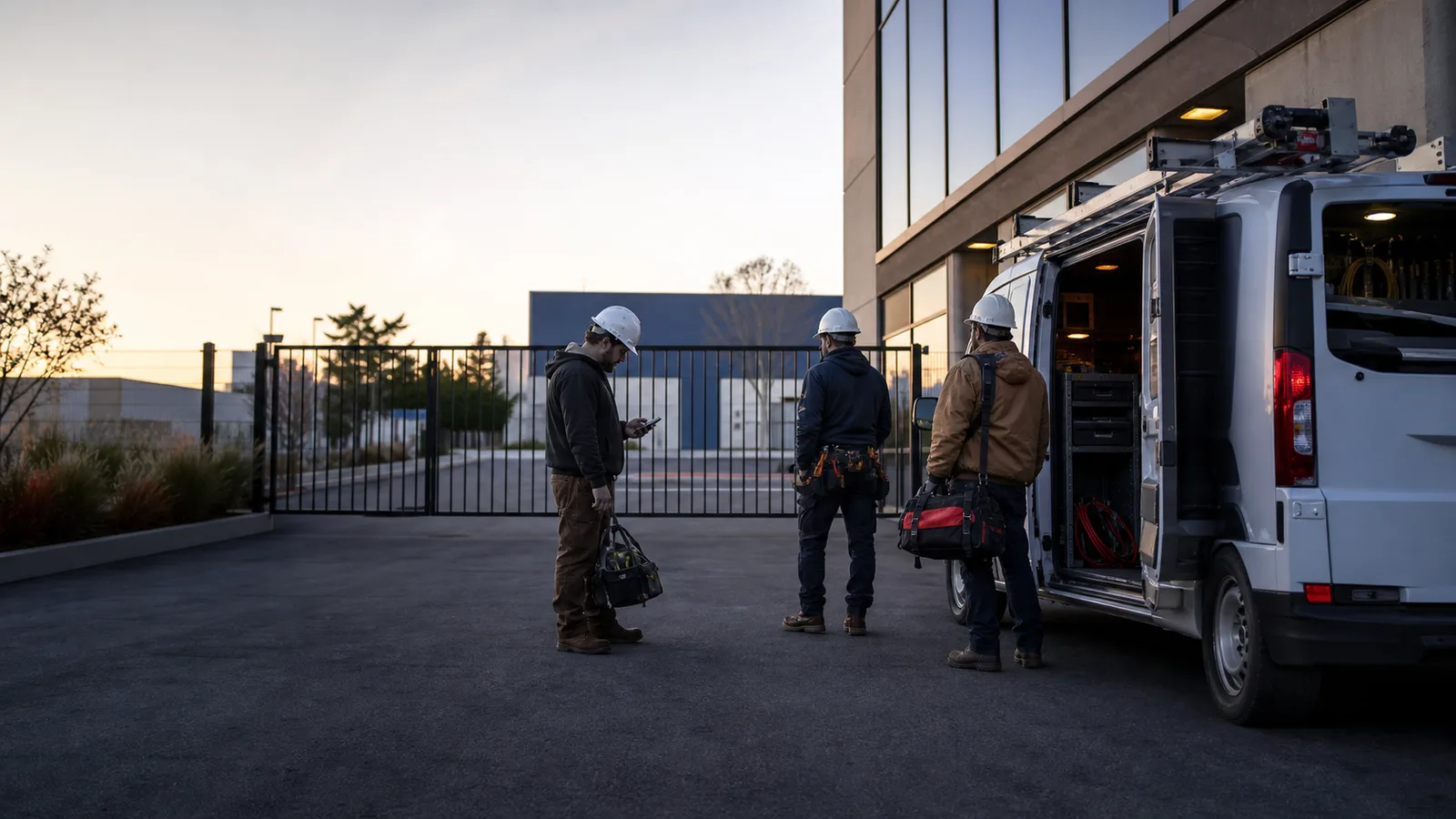
A foreman calls at 7:15 on a Tuesday. Four men are standing at the gate, the GC has no temp power on the second floor, and everybody is going home.
Two arguments start right there. The first one lands on Friday's payroll: electrician reporting time pay — show-up pay, call-in pay, same idea — for a morning that produced no work. The second one lands when you bill the GC for the trip.
Both get decided by the same thing: whether anybody wrote down what happened before the trucks pulled off the site. Usually nobody does, because a day with no work feels like a day with no paperwork.
This is the employer's side of the question. Most of what ranks for "show-up pay" is written for the worker filing a claim. This one is for the contractor deciding what to pay four guys who did nothing wrong.
One boundary first: billing a customer for time your crew spent waiting on site is a different ledger — that's standby and wait time billing. This post is about what you owe the worker who reported and got sent home.
This is not legal advice. Wage rules change and vary by state, wage order, and contract. Confirm anything below with your employment counsel and your state labor department before you run payroll on it.The Short Answer for the Contractor Writing the Check
There is no federal reporting time pay requirement. It is a state-law question, layered with whatever your collective bargaining agreement says — and a CBA can require show-up pay in a state that has no statute at all.
Four things decide the number:
- Where the work was. The state where the job sits generally governs, not where your shop is. Verify this if you cross a state line.
- What your agreement says. An IBEW inside agreement often sets a show-up minimum above the state floor. The higher obligation wins.
- Why the day ended. Most state rules carve out causes outside the employer's control. A GC who wasn't ready is usually not one of them.
- How long they were there. Rules that exist are typically written as a fraction of the scheduled shift with a floor and a ceiling.
Reporting Time Pay, Show-Up Pay, Call-In Pay: One Idea, Three Names
Reporting time pay is money owed to a worker who showed up for a scheduled shift and was sent home with little or no work. Show-up pay and call-in pay are the same concept under different names — the trade says "show-up," the statutes usually say "reporting time."
It is not the same as three things it gets confused with:
- On-call or standby pay — the worker is waiting to be called, not standing at your gate.
- Wait time on site — the crew is there and idle. Those are usually hours worked and paid as such.
- Travel time — a separate compensability question with its own rules, and it does not disappear because the day got called off.
Federal Law Is Silent. Your State May Not Be.
The Fair Labor Standards Act requires pay for hours worked. The U.S. Department of Labor has long taken the position that the FLSA does not require an employer to pay for time not worked when an employee is sent home early, and there is no federal reporting-time minimum.
So the obligation, if you have one, comes from state law or from your contract. The states most often cited are below. Treat these as a starting point to verify, not as the number to pay.
| State / district | Commonly cited reporting-time rule | What to check before you rely on it |
|---|---|---|
| California | Half the usual or scheduled day's work, no less than 2 hours and no more than 4, at the regular rate | Which IWC wage order covers you. On-site construction generally falls under Wage Order 16, which has its own text and its own exceptions |
| Massachusetts | Reporting pay of roughly 3 hours for a shift of 3 hours or more, with the unworked portion commonly payable at minimum wage | The current text of the reporting-pay regulation and how it treats scheduled shift length |
| New York | Call-in pay, typically a minimum number of hours at the basic minimum wage rate, with offsets against what the worker already earned that day | Which wage order applies to your work. Hospitality and building service have separate rules |
| New Jersey | Commonly cited as a 1-hour minimum for an employee who reports and is given less than an hour of work | The applicable rate and whether your workweek arrangement changes it |
| New Hampshire | Commonly cited as 2 hours at the regular rate for reporting to work at the employer's request | The statutory exceptions, including advance notice given to the employee |
| Washington, D.C. | Commonly cited as a minimum of 4 hours or the scheduled shift, whichever is less, for an employee who reports for a scheduled shift — so a normal 8-hour construction day lands at 4, while a scheduled 3-hour Saturday call lands at 3 | How the worked and unworked portions are rated, and whether your scheduled shift is short enough to change the number |
| Oregon | Its scheduling law is shaped around predictive scheduling and generally covers retail, hospitality, and food service | Whether it reaches construction at all — usually it does not |
Two more worth a look rather than an assumption. Connecticut keeps its reporting minimums inside industry-specific wage orders instead of one across-the-board rule, so the first question there is whether any of those orders reaches construction work at all. Rhode Island has a reporting-pay provision with its own trigger and its own number. Pull the current regulatory text for both before you pay against them — neither belongs in a table of numbers until you have read it.
Every other state: no general reporting-time requirement, which means your agreement and your own policy are the whole answer.
The California version, since it is the one people actually hit
California's wage orders require that a worker who reports as scheduled and is furnished less than half the scheduled day be paid for half the scheduled day, with a floor of two hours and a ceiling of four, at the regular rate.
If the same worker is called back a second time in the same workday and gets less than two hours on that second reporting, that second trip carries its own two-hour minimum. Service and callback work runs into this constantly.
The exceptions are narrow and worth reading in the order that covers you. They generally cover threats to workers or property, situations where civil authorities recommend work not begin, a public utility failure to supply power, water, gas, or sewer, and interruptions caused by an act of God or other cause outside the employer's control.
Read that last clause carefully. A general contractor who did not have the floor ready is a business decision, not an act of God — which is exactly why the same fact pattern that costs you show-up pay is often the fact pattern that supports a charge for the trip.
Your CBA Can Set a Higher Floor Than Your State
If you are signatory, read the agreement before you read the statute. IBEW inside agreements commonly carry a show-up or reporting clause, and the numbers vary local to local — some set one minimum for reporting and a larger one for a crew that was actually put to work before being released.
Two consequences most shops miss.
First, a CBA clause can create an obligation in a state with no reporting-time statute at all. Texas has no rule; your agreement might.
Second, the agreement often defines the things the statute does not — where reporting happens (shop or site), how travel is treated, and what a callback is worth. When the state floor and the contract floor differ, the higher one is what you pay.
Why the Day Ended Decides What You Owe and What You Can Charge
The reason the crew went home is the single fact that drives both halves of this. Sort every sent-home morning into "outside anybody's control" or "somebody upstream wasn't ready," because those two buckets get treated differently on both sides of the ledger.
| What ended the day | Show-up pay: likely posture | Charging for the trip: likely posture |
|---|---|---|
| Rain or weather that makes the work unsafe | Often the strongest case for an exception in states that have one, but not automatic — a forecast you knew about the night before undercuts it | Usually a weather-delay question governed by the contract, not a back-charge |
| No temp power, site not ready | Generally not an exception. This is a business condition, not an act of God | The strongest case for a delay or standby line, if your contract allows it and you gave notice |
| Failed inspection blocking your scope | Generally not an exception | Depends on whose inspection failed. If it was yours, you eat it |
| Another trade still in the wall or ceiling | Generally not an exception | Common delay claim. Names, times, and the area affected are what make it stick |
| Locked gate, no badge, no escort | Generally not an exception | Strong if documented at the gate, weak if reconstructed a week later |
| Utility outage at the site | One of the few causes commonly named in the exception language | Usually a force-majeure or excusable-delay question, not a charge |
| Material did not land | Generally not an exception | Depends entirely on who was furnishing it. Your gear, your problem |
| You canceled the night before and reached everyone | Nobody reported, so reporting-time rules generally are not triggered | Nothing to charge — but log the cancellation anyway |
| Worker sent home sick, unfit, or without required PPE | Fact-specific and the one most likely to become a dispute. Get advice before you make it a policy | Not chargeable |
What to Write Down Before the Trucks Leave
Six lines, written on the spot, settle both arguments. Miss them and you are relying on a foreman's memory of a morning that produced no work — and the law does not split that tie in your favor.
The FLSA puts the duty to keep accurate time records on the employer, not the worker. Under the burden-shifting standard from Anderson v. Mt. Clemens Pottery Co., when the employer's records are inadequate, the worker can carry their burden with a reasonable estimate of the hours, and it falls to you to come forward with evidence rebutting that estimate. Put plainly: a morning nobody wrote down is a morning the other side gets to describe.
Capture these:
- Date, job name, job number
- Who reported — full names, not "the crew"
- Arrival time — first man on site, by the clock, not rounded to the half hour
- Release time and who released them — name and company of the person who said go home
- Reason, in plain English — one sentence a stranger can follow
- Who you notified, how, and when — the PM, the super, the text, the time
Tue 8/12 — Riverside MOB, job 2417. Reported 6:58a: J. Ruiz, D. Okafor, M. Bell, T. Nguyen. GC super D. Alvarez confirmed no temp power to 2nd floor east. Released 7:20a, no work performed. PM notified by text 7:26a.
Compare that to what usually reaches the office: "2.0 hrs." The bare number proves nothing to a wage investigator and nothing to a GC. The line above answers both without a phone call.
Two habits that cost nothing and make the record much harder to argue with:
- Text the line to the super while you are still standing there. His reply — even "yeah, sorry about that" — is corroboration with a timestamp on it.
- Have the guys clock in even though they are being sent home. An arrival record is the thing you will wish you had, and a start time nobody recorded is a start time you cannot prove.
How to Code the Hours So Payroll and Job Cost Don't Fight
Put reporting time pay on its own earning line. Do not bury it in regular worked hours.
The reason is mechanical: pay for time not worked is generally excluded from the regular rate used to compute overtime, so treating it as ordinary hours can inflate an overtime calculation later in the week. Confirm the treatment with your payroll advisor — this interacts with state overtime rules and, in California, with daily overtime.
On the job-cost side, the cost still belongs to the job it happened on. Book it there, but flag it as non-productive so it does not quietly corrupt your hours-per-device or hours-per-fixture history. Leave 16 non-productive hours sitting against zero devices set and that job's history now reports those devices as having taken 16 hours longer than they actually did — so the next 200-device floor you bid off that history gets estimated high, and you either lose the job or carry padding you can't explain to the customer who asks. More on that in the job costing walkthrough.
On public work, do not guess. How non-productive reporting hours appear on certified payroll — and whether fringe obligations attach — is a question for the awarding agency's compliance officer, in writing, before the payroll goes in.
Whatever you use to capture the clock — paper, a spreadsheet, or something like FieldTimesheet, which timestamps the clock-in with a location point and takes the crew's own note of what happened — the coding is still yours to do. It has no travel, standby, or non-productive categories and does not run payroll; it records who reported, when, to which job, and why the day ended.
Worked Example: One Turned-Away Morning, Three Jurisdictions
Numbers below are example arithmetic with the inputs stated. They are not a claim about your business. Run it with your crew size, your rate, and your state.
Inputs: 4 electricians · 8-hour scheduled day · $46/hr assumed straight-time cost rate · sent home 22 minutes after arrival, no work performed.| Scenario | Hours owed per worker | Crew hours | Payroll cost of the morning |
|---|---|---|---|
| California-style rule: half of an 8-hour scheduled day, capped at 4 | 4.0 | 16.0 | 16.0 × $46 = $736 |
| Agreement with a 2-hour show-up clause, state has no statute | 2.0 | 8.0 | 8.0 × $46 = $368 |
| No state rule, no agreement clause, no company policy | 0.0 for unworked time | 0.0 | $0 in wage obligation — the trip still cost you the morning |
Same four men, same locked floor, same 22 minutes. The spread between the rows is jurisdiction and contract, which is why "what do I owe" is never a question you can answer from a blog table alone.
The other half of the ledger, priced
Same inputs, now on the billing side. Assume a T&M rate schedule with a $95/hr bill rate — a different number doing a different job than the $46 cost rate above.
- Rate schedule allows a 2-hour minimum call: 4 men × 2.0 hrs × $95 = $760 on the invoice
- Rate schedule allows the 4 reported hours you actually paid: 4 men × 4.0 hrs × $95 = $1,520
- Rate schedule is silent on non-productive time: $0 until you negotiate it after the fact, which is the weakest ground to negotiate from
Note what does not change across any of these rows: you burned a morning of crew capacity you had already committed. Whether any of it comes back depends on the record, not on the rule.
Charging the GC for the Trip: T&M vs. Lump Sum
Which contract you are on decides the entire shape of the charge, so check that before you check anything else.
On a T&M or cost-plus agreement, the reported hours are frequently billable under the labor rate schedule already in the contract, the same as any other hours — subject to whatever that schedule says about non-productive, standby, or minimum-call time. Read the rate schedule first: it either has a line for this or it doesn't, and that answer is the whole answer. On a lump-sum or fixed-price contract, there is no hourly line to hang it on. The same morning has to be converted into a delay or impact claim — you are not billing hours, you are asserting that somebody else's failure cost you productive time against a fixed price. Read the delay, changes, and notice articles first.Either way, notice is what decides whether the charge survives. Look at the Delays or Claims article of your subcontract for the written-notice window; many run 24 to 72 hours from the event. A charge that shows up on the invoice three weeks later with no notice in between is the one that gets rejected — not because the trip didn't happen, but because the contract said tell me now and nobody did.
The evidence is the same six lines you already wrote at the gate: who reported, when they arrived, who released them, why, and who you told. Presented that way, a trip charge reads as a documented event rather than a padded line. The mechanics of building that backup are covered in T&M billing best practices, and there is an annotated sample billing packet showing what a customer-readable version looks like.
The Same Record Ends Both Arguments
The crew's own note is the thing that does double duty here. It is the payroll record proving the reporting obligation was triggered and satisfied, and it is the explanation the GC reads before approving a charge.
A payroll line reading "2.0 hrs" survives neither. "Tue 6:58a — 4 men on site, GC had no power to the floor, released 7:20a" survives both, and it took nine seconds to write.
That is the whole method, and it works on paper. The hard part is not the form — it is getting a sentence out of a man who is annoyed, already in the truck, and convinced nobody reads it. Tell him the truth: it is the reason he gets paid for the morning and the reason the company gets paid for the trip. What to actually write on a timesheet covers the wording that gets used versus the wording that gets ignored.
If you want forms to start from, the T&M Billing Backup Kit has a labor backup sheet and a daily field report you can print. Neither is a sent-home sheet out of the box — add the six fields above to the daily field report and you have one.
Frequently Asked Questions
Do I have to pay my electricians if it rains?It depends on your state and your agreement. Weather that genuinely makes the work unsafe is the scenario most likely to fall under an act-of-God style exception where one exists — but the exception is not automatic, and it gets weaker if the forecast was known and you called the crew out anyway. If you have no state rule and no CBA clause, this is a policy decision, not a legal one.
Does show-up pay count toward overtime?Generally no. Pay for hours not worked is typically excluded from the regular rate used to compute overtime, which is exactly why it should sit on its own earning line instead of being entered as worked hours. Confirm the treatment with your payroll advisor, because it interacts with daily overtime rules in states like California.
Can I bill the GC for a morning my crew got sent home?On a T&M or cost-plus contract, often yes — as a labor line under the rate schedule already in the agreement, if that schedule covers non-productive or minimum-call time. On lump sum there is no hourly line to use, so the same morning becomes a delay or impact claim instead. Both paths die the same way: no written notice inside the window your subcontract requires.
Does my state's rule control, or does our IBEW agreement?Both apply, and you pay the higher obligation. A collective bargaining agreement can require show-up pay in a state with no statute, and it can set a larger minimum than a state that has one. Read the agreement first — it is the document more likely to have a number in it.
Which state's rule applies if my shop is in one state and the job is in another?The general rule of thumb is that the state where the work is performed governs. For a shop working near a state line or across a metro, that means the same crew can be under different rules on Monday and Tuesday. Verify with counsel rather than assuming your home state travels with the truck.
Do I owe show-up pay if I called the crew the night before?Usually not, if you actually reached them and they never reported. Reporting-time rules generally trigger on reporting. The failure mode is a group text that two guys never saw — so log who you reached, how, and when, the same as you would log the sent-home morning.
Is drive time to the jobsite the same thing as reporting time pay?No. Travel compensability is a separate question with its own rules, and it can apply on a day where reporting time pay does not. If you require the crew to report to the yard first and then ride out, look at that arrangement specifically — it changes the analysis.
What if a guy shows up unfit for work or without his PPE and I send him home?That is the most fact-specific row in the table and the most likely to become a dispute. Some rules contemplate exceptions tied to the worker's own conduct; others do not. Document what happened and get advice before you turn it into a standing policy.
How long should I keep the sent-home record?Keep it at least as long as the longest window that could reach back for it. FLSA claims generally run 2 years, or 3 if the violation was willful; state wage-claim periods commonly run 2 to 6 years, so check yours specifically. These disputes surface long after the morning is forgotten, and the whole problem with a sent-home day is that it generated almost no paper in the first place.