The GC's project manager has your T&M invoice on his desk. He has no problem with the rough-in hours.
He circles one line. Material handling — 4.25 hrs. Then he asks what that was.
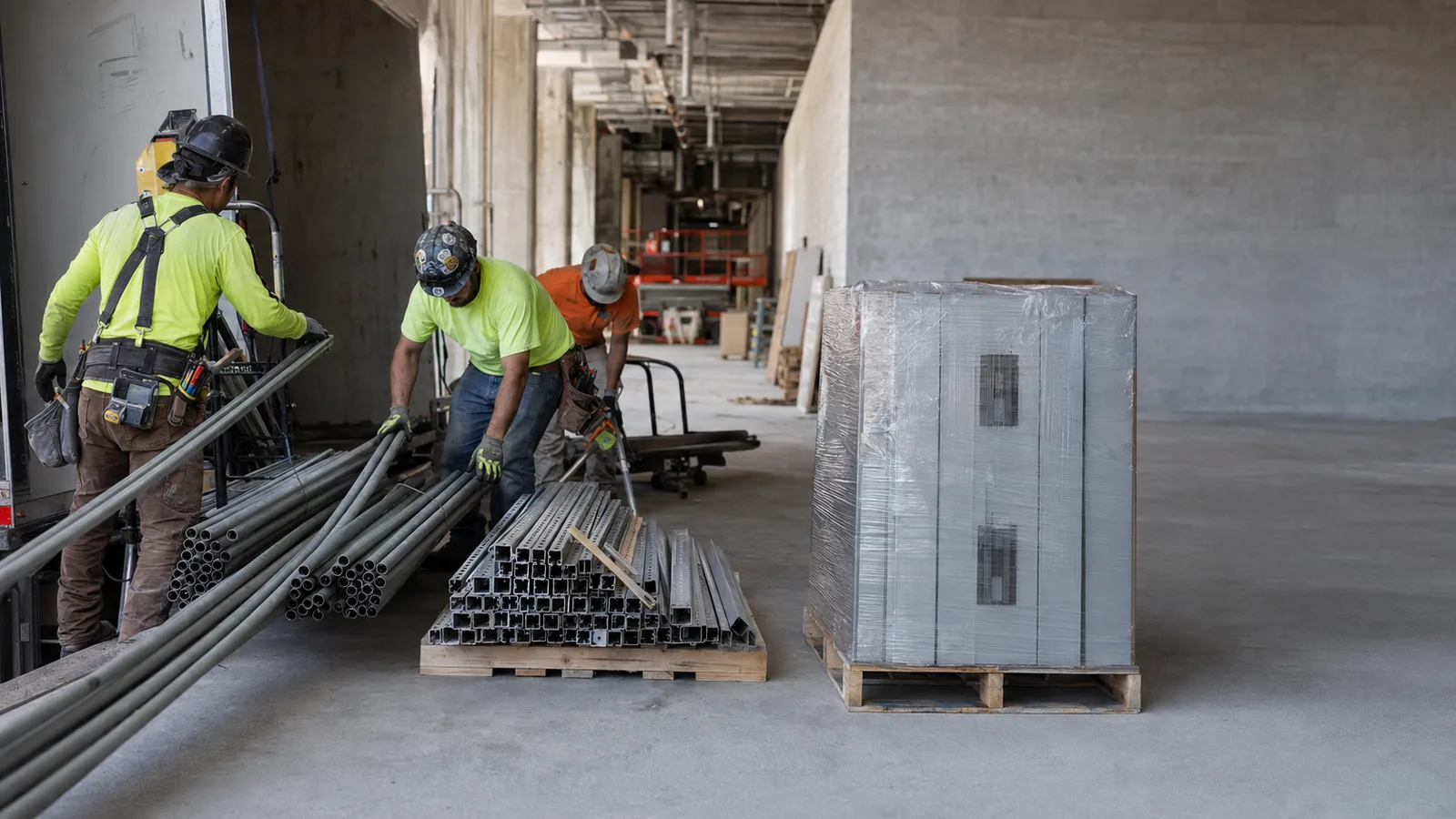
Electrician material handling and stocking hours billing lives or dies in that thirty seconds. The hours were real. Two men took a gear delivery at the curb, hoisted it, and staged it by floor.
But the invoice line does not say any of that. It says a number, so it reads like padding, and it is the first thing struck.
The charge was fair. The explanation was missing.
This post covers the whole question: which handling hours are billable labor, when the material markup has already paid for them, the clause that settles it in advance, and how to write the line so it survives review. All of it works on a paper timesheet.
Are Material Handling and Stocking Hours Billable on a T&M Job?
Material handling and stocking hours are usually billable on a T&M job, as long as your contract's labor definition covers the work and the material markup is not already paying for the same thing. Handling hours are labor. The markup buys procurement, not man-hours of hoisting.
Two tests decide every line, in this order.
Test one: is this work already inside the markup? If you bought and marked up the material, part of getting it is already paid for. If the material is owner-furnished, none of it is. Test two: can the customer rebuild the charge from the backup? A billable hour nobody can reconstruct is a struck hour. That test is harder than the first one, and it is the one that gets ignored.Where the Double-Dip Objection Comes From
Your invoice already carries a material line with a markup on it. When a separate stocking line shows up underneath, the GC reads it as the same work billed twice.
He is not being unreasonable. From his side of the desk, the markup is already what he is paying for getting material to the job.
The reconciliation is that "handling" is two different jobs wearing one word.
| Procurement (what the markup buys) | Physical handling (labor) |
|---|---|
| Takeoffs, POs, calls to the supply house, chasing lead times | Meeting the truck, receiving, inspecting, checking against the packing slip |
| Carrying the material cost until the invoice gets paid | Hoisting and distributing to floors, wings, and electrical rooms |
| The account, the warehouse, the truck, the office time | Cutting, bending, reeling, and staging by area |
| Return paperwork and credits | Moving the same material a second time after a schedule change |
A markup is sized against the cost of the material. It was never sized against ten man-hours of stair and elevator work on a gear drop.
Example arithmetic. A 14,000 dollar material package at 20 percent markup produces 2,800 dollars. Two electricians spend 5.0 hours each receiving, hoisting, and staging it, so 10.0 man-hours at a 92 dollar bill rate is 920 dollars. Run it with your own package size, crew, and rate.Both numbers are defensible, and they are paying for different work. The problem is that nothing on the invoice says so.
Now change one input. Same 10.0 man-hours, but the gear is owner-furnished. The markup is zero, because you never bought the material, so if the hours do not go on the labor line, nobody ever pays for that day.
Billable, Not Billable, or Depends: The Handling Lines That Get Argued
Here is the default answer for each line an electrician actually fights about, and the fact that changes it. Settle these with the GC once, in the authorization, instead of once per invoice.
| The hours | Default | What changes the answer |
|---|---|---|
| Supply house run for this job | Billable | Whether the contract pays portal to portal or site to site. A trip that also restocks the van generally is not fully billable to one customer. |
| Pulling material from truck or van stock | Usually absorbed | Billable when it is a dedicated stocking task, not the minute spent reaching into the bin during the install. |
| Shop or warehouse staging: bending pipe, building panels, reeling wire | Billable | Whether the contract allows off-site labor at all. Check whether your labor definition covers off-site hours. If it does not say, shop staging has no home and gets argued at invoice time. |
| Loading the truck at the shop | Usually overhead | Billable when it is a dedicated run for a delivery the customer asked for, not the normal morning load-out. |
| Receiving, unloading, and inspecting a delivery | Billable | Whether a man had to come off the tools to meet the truck, and who set the delivery window. |
| Hoisting and distributing by floor or area | Billable | Very little. This is install-adjacent labor no markup was ever sized for. Name the floors in the note. |
| Handling owner-furnished material | Billable | Nothing, but say it in writing first. There is no markup on material you did not buy, so this is pure labor or it is free. |
| Returns and restocking unused material | Depends | Who caused it. A customer-driven change or cancellation makes the return trip billable. Over-ordering on your own is yours to eat. |
| Re-handling after a schedule change or another trade moved it | Billable | Whether you can name who moved it, when, and why. Without that, it reads as your own inefficiency. |
| Waiting on a late delivery | Depends | Whether the authorization has standby language, and who controlled the delivery window. |
Check where your own contract puts it. Cost-plus and reimbursable-cost provisions sometimes list transportation, delivery, and storage of material under material costs rather than labor, which changes the answer for the same hours. Look at the reimbursable-costs section of the agreement you signed before you build the invoice.
Four Ways to Bill Handling Hours, With the Arithmetic
There are four ways to bill these hours. Pick one on purpose and write it down. The worst outcome is picking a different one each month and letting the customer notice.
All four rows below use the same inputs: 10.0 man-hours of handling, a 92 dollar standard bill rate, and a 14,000 dollar material package.
| Method | What the customer sees | Example arithmetic | Holds up when |
|---|---|---|---|
| Standard labor rate | Handling hours on their own line at the install rate | 10.0 hrs at 92 dollars equals 920 dollars | The authorization lists handling as billable labor and each line carries a description of the work |
| Reduced handling rate | A separate, lower, named rate for non-productive time | 10.0 hrs at 65 dollars equals 650 dollars | You would rather trade rate for an argument you never have. Get the second rate on the signed rate schedule |
| Percentage handling fee on material | One percentage line instead of handling hours on the labor line | 8 percent of 14,000 dollars equals 1,120 dollars | Material is owner-furnished, or the GC would rather approve one number than a timesheet |
| Absorbed in the markup | Nothing at all | Zero on this invoice | Handling volume is small, predictable, and genuinely priced into the markup you charge |
One thing to be clear about, because the customer will ask: the percentage handling fee replaces the handling hours on the labor line, not the material markup. Pick the fee or the hours for a given delivery, never both, or you have built the double-dip the GC is already looking for.
Same day, four defensible answers between zero and 1,120 dollars. That spread is not a pricing question. It is a contract question, and it is settled in one paragraph before the truck shows up.
The Clause to Put in the T&M Authorization
One paragraph, signed before the first hour, ends most of this. Put it next to the labor rates in the authorization, not in an email after the delivery.
Material handling and stocking. Labor spent receiving, inspecting, unloading, hoisting, staging, distributing, and returning material for this scope is billable at the labor rates listed above, in addition to material cost and the agreed material markup. The material markup covers procurement and administration only. Handling hours will be recorded on the daily field ticket with the material described, where it came from, and where it was staged. Owner-furnished material is handled at the same labor rates.
If the GC will not sign an open handling line, cap it instead of dropping it.
Handling hours are billable up to 4.0 man-hours per delivery. Hours beyond that require prior written approval.
Then put one sentence in the proposal so the invoice is not the first time anybody hears about it: deliveries are received, hoisted, and staged by our crew at the labor rates above, and the material markup covers procurement only.
The free T&M work authorization in the T&M Billing Backup Kit already has a section for what else is billable, including travel, supply house runs, and markup. Paste the paragraph above into it and the handling question is closed before the job starts.
Write the Line So It Does Not Get Struck
"Material handling — 4.25 hrs" asks the customer to take your word for it. A line that names the material, the route, and the area it served answers the question before anyone asks it.
Here is the same 4.25 hours, and three other common lines, written both ways.
| Gets struck | Gets approved |
|---|---|
| Material handling, 4.25 hrs | Tue 6:58a to 11:12a — received and distributed 3/4 EMT and strut to floors 2 through 4, staged panels HP-2A and HP-2B in east electrical room. Owner-furnished, dropped at grade by others. |
| Supply house run, 1.5 hrs | Wed 6:40a to 8:10a — picked up 500 ft of #12 THHN, two 42-circuit panels and fittings at will-call for second-floor east rough-in, delivered and staged on 2. |
| Material handling, 3.0 hrs | Thu 1:00p to 4:00p — re-staged MC and strut from level 3 north to level 4 after drywall start moved up per Friday's schedule revision. |
| Stocking, 2.25 hrs | Mon 7:00a to 9:15a — received owner-furnished gear, two 400A sections, checked against packing slip 88412, staged in main electrical room. One section short-shipped. |
Nothing changed but the sentence. The right-hand column cannot be reduced to "what was that," because it already said.
Four things a handling note has to carry:
- What material, in trade terms, with a rough count. "500 ft of #12 THHN and 24 four-square boxes," not "supplies."
- From where, to where. Curb to third floor. Supply house to site. East wing to west wing.
- What it was for. The phase or area the material serves, such as second-floor east rough-in or the MDP feeder.
- Why it took a trip at all. Owner-furnished, a GC-set delivery window, a re-handle after the schedule moved. This is the sentence that turns a questioned line into an approved one.
The failure mode is always the same. Somebody pulls material off the truck, the foreman means to write it down, and on Friday he is reconstructing the week from memory. The trips he cannot remember are the ones you do not bill.
What works is asking for one sentence when the day ends, not a form at the end of the week. An index card in the truck, a line on the daily field report, or a text to the office at quitting time all do the job. A time app can prompt for it too — FieldTimesheet asks "what did you work on?" at clock-out and prints that note on the customer's billing packet — though it records hours and notes, not materials, so the packing slip is still on you. A card taped to the dash costs nothing and works the same day.
To see what the finished document looks like when the notes are actually there, the sample billing packet is public and ungated.
The Paperwork That Backs the Hours
Hours need a second source. Staple the paper that proves someone was there, doing that, at that time.
- The delivery ticket or packing slip, with the delivery time and the receiver's name on it.
- The will-call receipt from the supply house. The time stamp is the whole point.
- The signed daily field report for that day, with handling broken onto its own line.
- The hoist or freight elevator log, if the GC keeps one. It is their paper, which makes it hard to argue with.
- The email, RFI, or schedule revision that caused a re-handle.
- For owner-furnished material, the transfer or receipt showing what arrived and what was short.
Get It Approved Before the Invoice, Not After
Handling hours are cheap to approve on the day they happen and expensive to defend thirty days later. Every step below works with a clipboard and a pen.
- Before the work. Get the handling paragraph into the signed T&M authorization, next to the rates.
- At the delivery. One sentence on the ticket while the truck is still there: material, route, area, reason.
- Same day. Put handling on its own line on the daily field report, never buried inside "labor," and get the superintendent's signature that day rather than that week.
- Same week. Hand or send the signed tickets to the GC before the invoice goes out. The invoice should contain no line the PM is seeing for the first time.
- On the invoice. Carry the note text onto the backup sheet. Summarize hours on the invoice, describe them on the backup.
- If a line gets questioned. Send the reconstruction first: ticket, note, packing slip, elevator log. Ask for that specific line to be reinstated. Do not open with a discount.
- If they still will not pay it. Offer a per-delivery handling allowance going forward rather than conceding the hours were not real. You are negotiating the mechanism, not admitting the work.
Frequently Asked Questions
Can I bill material handling hours if I already charge a markup on the material?You can bill handling hours alongside a material markup when the two are paying for different work and the contract says so. The markup covers procurement, ordering, and carrying cost. Physical handling — receiving, hoisting, distributing, re-staging — is labor. Say that out loud in the authorization or it reads as double-billing.
Are supply house runs billable on a T&M job?A supply house run for a specific job is usually billable, when the contract's travel language covers it. A run that also restocks the van is not fully billable to one customer, so split it or bill only the portion that served the job. Write the material and the phase it was for on the ticket.
Who pays for handling owner-furnished material?The customer pays for handling owner-furnished material, on the labor line. There is no markup to cover it because you never bought the material. This is the easiest one to lose by forgetting to raise it, and the easiest one to win with a single sentence in the authorization.
Should stocking hours be billed at the journeyman rate or a lower rate?Stocking hours can be billed at either rate, as long as it is the rate on the signed schedule. A second, lower handling rate named on that schedule takes the argument off the table; billing standard and letting the description carry it works too. What loses is inventing a rate at invoice time.
Is shop time like bending pipe or building panels billable to a T&M job?Shop time is billable when the contract permits off-site labor for that scope. If your authorization defines on-site hours only, shop staging falls outside it, and nobody notices the gap until the invoice. Add off-site labor to the labor definition before the work happens, not after.
What do I do when the GC strikes handling hours off the invoice?Send the backup, not a discount. Ticket, field note, packing slip with the delivery time, and the elevator log if there is one, then ask for that line specifically to be reinstated. If the answer is still no, propose a per-delivery handling allowance so the same argument does not repeat next month.
How do I record handling hours if the crew still uses paper timesheets?Add one line to the daily ticket: time in and out for the handling window, the material, where it went, and why it took a trip. Paper is fine, because the description carries the weight, not the medium. Collect tickets daily rather than Friday, since a Friday reconstruction is always short.
Does a photo of the staged material help?A photo of the staged material helps, and it costs nothing. A phone photo of the pallet in the electrical room, filed with the ticket, closes the "was it even delivered" version of the argument. It does not replace the note, because a picture does not say how long it took or who did it.
The Short Version
None of this needs software. It needs one paragraph signed before the delivery, one sentence written the day the work happens, and the right paper stapled behind it.
Do that and the handling line stops being the first thing struck, because it becomes the one line on the invoice that already explains itself.